
Ibn Rushd in Córdoba: Reason and Faith in Times of Uncertainty
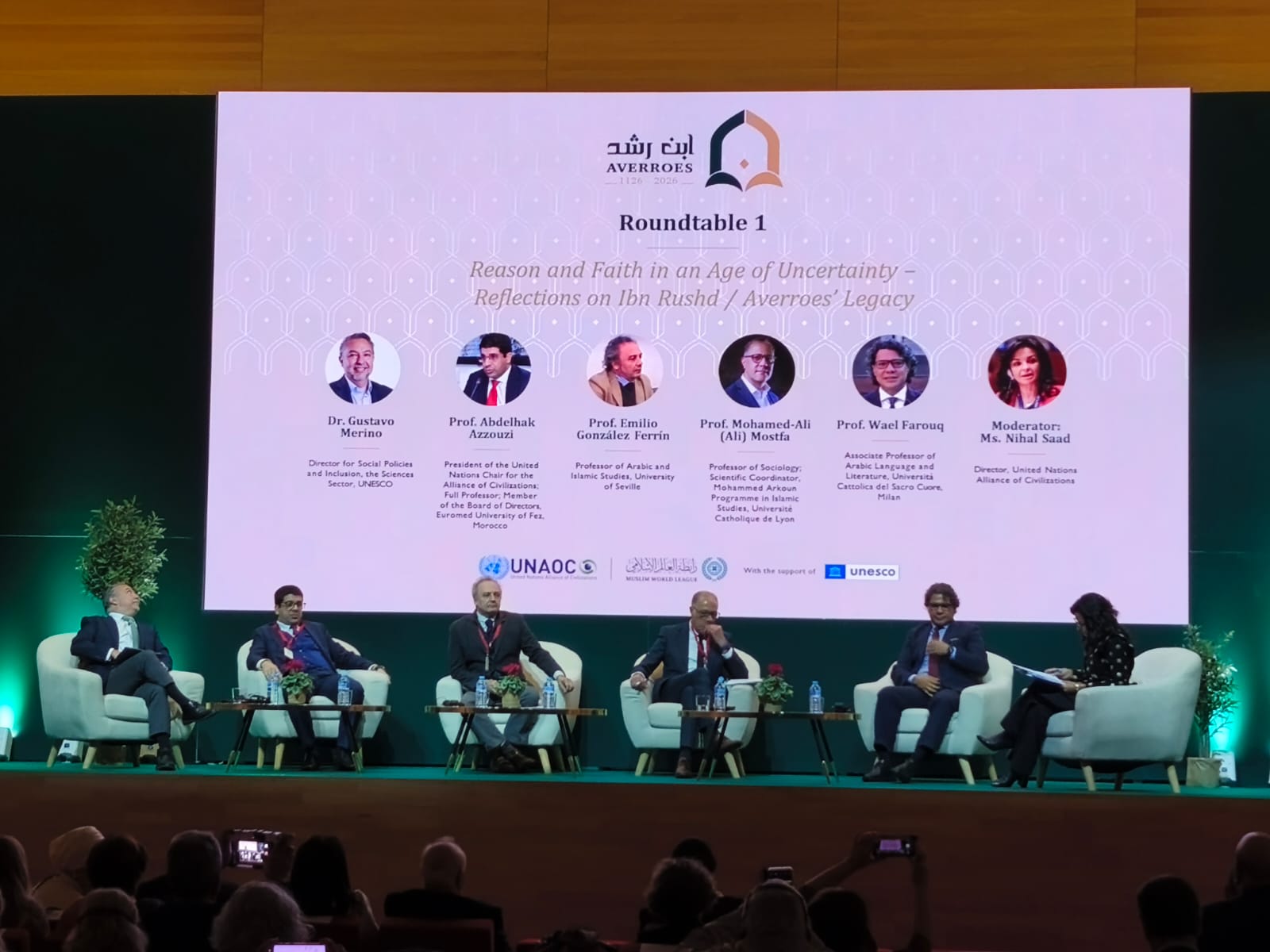
On 10 November 2026, the Córdoba Conference Centre hosted the international conference “The International Year of Ibn Rushd / Averroes: An Opportunity for Reason”, co-organised by the United Nations Alliance of Civilizations (UNAOC), the Muslim World League and Espacio Tierra Creativa, with the support of UNESCO and several Andalusian institutions, to mark the 900th anniversary of the philosopher’s birth (1126).
Ali Mostfa, Professor of Sociology at the Catholic University of Lyon, scientific delegate of Pluriel and scientific co-coordinator of the Mohammed Arkoun programme, took part in the first round table, “Reason and Faith in an Age of Uncertainty: Reflections on Ibn Rushd / Averroes’ Legacy”. Moderated by Nihal Saad, Director of UNAOC, it also brought together Gustavo Merino (UNESCO), Abdelhak Azzouzi (Euromed University of Fez), Emilio González Ferrín (University of Seville) and Wael Farouq (Università Cattolica del Sacro Cuore, Milan).
Drawing on the Faṣl al-maqāl (The Decisive Treatise), the talk recalled that this text of 1180 is first and foremost a judge’s answer to a legal question: does philosophy have a place in religion? Three of Ibn Rushd’s ideas were set against today’s challenges of polarisation: the claim that “truth does not contradict truth”, the diversity of the paths by which human beings arrive at conviction (demonstration, dialectic, rhetoric), and the duty to learn from those who came before us, “whether or not they share our religion”.
The talk also highlighted Ibn Rushd’s caution regarding excommunication (takfīr) and his clear-sighted account of how sects arise, leading “to hatred and wars”. In the spirit of Mohammed Arkoun, it stressed the role of education: learning to distinguish proof from image, and opening knowledge to all. Finally, it recalled that Ibn Rushd’s philosophical work, long read in Europe through the eyes of his opponents, was rediscovered in the Arab world at the time of the Nahḍa.
In conclusion, the talk argued for a reading of Ibn Rushd that makes him neither the emblem of a triumphant reason nor the ancestor of all our values, but a thinker whose texts, read in their context and with their limits, help us to think about the conditions of debate and coexistence today.
Further reading
- “Córdoba celebra a Ibn Rushd en evento de la ONU, Liga Islámica y Espacio Tierra”, Córdoba Buenas Noticias;
- “The Mosque Foundation of Seville attends the Ibn Rushd / Averroes International Congress in Cordoba”, Mosque Foundation of Seville;
- “Destacadas personalidades internacionales reivindican el legado de Averroes en los 900 años de su nacimiento”, Córdoba Hoy.
Le 10 novembre 2026, le Palais des congrès de Cordoue a accueilli la conférence internationale « The International Year of Ibn Rushd / Averroes: An Opportunity for Reason », coorganisée par l’Alliance des civilisations des Nations unies (UNAOC), la Ligue islamique mondiale et Espacio Tierra Creativa, avec le soutien de l’UNESCO et de plusieurs institutions andalouses, à l’occasion du neuf-centième anniversaire de la naissance du philosophe (1126).
Ali Mostfa, professeur de sociologie à l’Université catholique de Lyon, délégué scientifique de Pluriel et co-coordinateur scientifique du parcours Mohammed Arkoun, a participé à la première table ronde, « Reason and Faith in an Age of Uncertainty: Reflections on Ibn Rushd / Averroes’ Legacy ». Modérée par Nihal Saad, directrice de l’UNAOC, elle réunissait également Gustavo Merino (UNESCO), Abdelhak Azzouzi (Euromed University of Fez), Emilio González Ferrín (Université de Séville) et Wael Farouq (Université catholique du Sacré-Cœur, Milan).
Prenant appui sur le Faṣl al-maqāl (Discours décisif), l’intervention a rappelé que ce texte de 1180 est d’abord la réponse d’un juge à une question juridique : la philosophie a-t-elle sa place dans la religion ? Trois idées d’Ibn Rushd ont été mises en regard des enjeux actuels de polarisation : l’affirmation que « la vérité ne contredit pas la vérité », la diversité des voies par lesquelles les êtres humains parviennent à la conviction (démonstration, dialectique, rhétorique), et l’exigence d’apprendre de ceux qui nous ont précédés, « qu’ils partagent ou non notre religion ».
L’intervention a aussi souligné la prudence d’Ibn Rushd face à l’excommunication (takfīr) et sa description lucide de la naissance des sectes, qui mène « à la haine et aux guerres ». Dans l’esprit de Mohammed Arkoun, elle a insisté sur le rôle de l’éducation : apprendre à distinguer la preuve de l’image, et ouvrir le savoir à tous. Elle a enfin rappelé que l’œuvre philosophique d’Ibn Rushd, longtemps lue en Europe à travers ses adversaires, a été redécouverte dans le monde arabe au moment de la Nahḍa.
En conclusion, l’intervention a plaidé pour une lecture d’Ibn Rushd qui ne fasse de lui ni l’emblème d’une raison triomphante, ni l’ancêtre de toutes nos valeurs, mais un penseur dont les textes, lus dans leur contexte et avec leurs limites, aident à penser les conditions du débat et de la coexistence aujourd’hui.
Pour en savoir plus
- « Córdoba celebra a Ibn Rushd en evento de la ONU, Liga Islámica y Espacio Tierra », Córdoba Buenas Noticias ;
- « The Mosque Foundation of Seville attends the Ibn Rushd / Averroes International Congress in Cordoba », Fondation de la mosquée de Séville ;
- « Destacadas personalidades internacionales reivindican el legado de Averroes en los 900 años de su nacimiento », Córdoba Hoy.
في 10 نوفمبر/تشرين الثاني 2026، احتضن قصر المؤتمرات في قرطبة المؤتمر الدولي «السنة الدولية لابن رشد: فرصة للعقل»، الذي نظّمه تحالف الأمم المتحدة للحضارات ورابطة العالم الإسلامي ومؤسسة Espacio Tierra Creativa، بدعم من اليونسكو وعدد من المؤسسات الأندلسية، بمناسبة الذكرى التسعمئة لميلاد الفيلسوف (1126).
وشارك علي مصطفى، أستاذ علم الاجتماع في الجامعة الكاثوليكية في ليون، والمندوب العلمي للمنصة الجامعية للدراسات حول الإسلام، والمنسّق العلمي المشارك لمسار محمد أركون، في الطاولة المستديرة الأولى بعنوان «العقل والإيمان في زمن اللايقين: تأمّلات في إرث ابن رشد». وقد أدارتها نهال سعد، مديرة تحالف الأمم المتحدة للحضارات، وشارك فيها أيضًا غوستافو ميرينو (اليونسكو)، وعبد الحق عزوزي (الجامعة الأورومتوسطية بفاس)، وإميليو غونزاليس فيرين (جامعة إشبيلية)، ووائل فاروق (الجامعة الكاثوليكية للقلب المقدّس، ميلانو).
وانطلاقًا من «فصل المقال»، ذكّرت المداخلة بأن هذا النصّ الذي كُتب سنة 1180 هو في الأساس جواب قاضٍ عن سؤال فقهي: هل للفلسفة مكان في الدين؟ ووُضعت ثلاث أفكار لابن رشد في مقابل رهانات الاستقطاب الراهنة: التأكيد أن «الحق لا يضادّ الحق»، وتنوّع الطرق التي يبلغ بها البشر التصديق (البرهان والجدل والخطابة)، وضرورة الأخذ عمّن سبقنا، «سواء كان مشاركًا لنا أو غير مشارك في الملّة».
كما أبرزت المداخلة حذر ابن رشد من التكفير، ووصفه الثاقب لنشوء الفِرَق الذي يفضي إلى التباغض والحروب. وعلى خطى محمد أركون، شدّدت على دور التربية: تعلّم التمييز بين البرهان والصورة، وفتح باب المعرفة للجميع. وذكّرت أخيرًا بأن المتن الفلسفي لابن رشد، الذي طالما قُرئ في أوروبا من خلال خصومه، أُعيد اكتشافه في العالم العربي في عصر النهضة.
وفي الختام، دعت المداخلة إلى قراءة لابن رشد لا تجعل منه رمزًا لعقل منتصر ولا جدًّا لكل قيمنا، بل مفكّرًا تساعد نصوصه، إذا قُرئت في سياقها وبحدودها، على التفكير في شروط الحوار والتعايش اليوم.
للاستزادة
- Córdoba celebra a Ibn Rushd en evento de la ONU, Liga Islámica y Espacio Tierra، موقع Córdoba Buenas Noticias (بالإسبانية)؛
- The Mosque Foundation of Seville attends the Ibn Rushd / Averroes International Congress in Cordoba، مؤسسة مسجد إشبيلية (بالإنجليزية)؛
- Destacadas personalidades internacionales reivindican el legado de Averroes en los 900 años de su nacimiento، صحيفة Córdoba Hoy (بالإسبانية).
The International Year of Ibn Rushd / Averroes: An Opportunity for Reason, UNAOC, Córdoba, 10 November 2026.


Resources related to Philosophy
videos
Artificial Intelligence, a New God? Christian and Muslim Perspectives
On 20 October 2026, the Centre for Interreligious Studies (ZIRS) at the University of Innsbruck, a partner institution of Pluriel, opened the semester of its online interreligious conversation seri...

article
Literary, Semiotic and Hermeneutical Approaches to the Qur’an in the Modern Period
- Wasim Salman
Abstract In this contribution to issue 51 (Mélanges) of the journal Islamochristiana, published in Italian as Approcci letterari, semiotici ed ermeneutici al Corano nel periodo moderno, Wasim Sa...
article
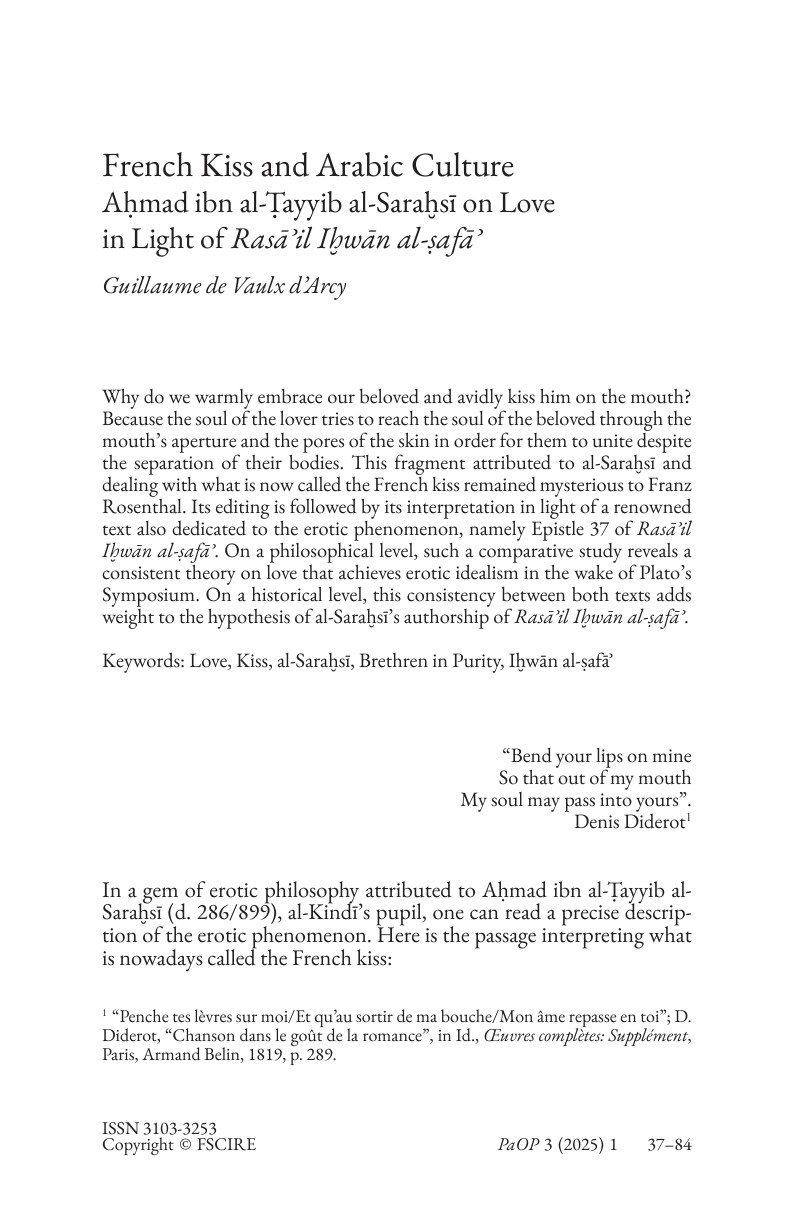
French Kiss and Arabic Culture: Aḥmad ibn al-Ṭayyib al-Saraḫsī on Love in Light of Rasāʾil Iḫwān al-ṣafāʾ
- Guillaume de Vaulx d'Arcy
Abstract Published in the Palermo Occasional Papers of the Foundation for Religious Sciences (FSCIRE) (vol. 3, no. 1, 2025, pp. 37-84), this article by Guillaume de Vaulx d'Arcy, associate resea...

videos
Spiritual eroticism and erotic spirituality in Sufi mystical thought
Paper presented at the 5th international congress of the University Platform for Research on Islam (Pluriel), held in Cordoba from 10 to 14 February 2026 on the theme "Ethics and Aesthetics in Isla...

videos
Defining the beautiful in Islam: between submission to and transgression of ethical norms
Paper presented at the 5th international congress of the University Platform for Research on Islam (Pluriel), held in Cordoba from 10 to 14 February 2026 on the theme "Ethics and Aesthetics in Isla...

videos
The gnostic constitution of aesthetic values in Ibn ʿArabī
Paper presented at the 5th international congress of the University Platform for Research on Islam (Pluriel), held in Cordoba from 10 to 14 February 2026 on the theme "Ethics and Aesthetics in Isla...

videos
Art in the face of authoritarian discourse: the contribution of Nasr Hamid Abu Zayd
Paper presented at the 5th international congress of the University Platform for Research on Islam (Pluriel), held in Cordoba from 10 to 14 February 2026 on the theme "Ethics and Aesthetics in Isla...

videos
Ethics and aesthetics in the thought of Abū Ḥayyān al-Tawḥīdī (d. 414/1023)
Paper presented at the 5th international congress of the University Platform for Research on Islam (Pluriel), held in Cordoba from 10 to 14 February 2026 on the theme "Ethics and Aesthetics in Isla...