
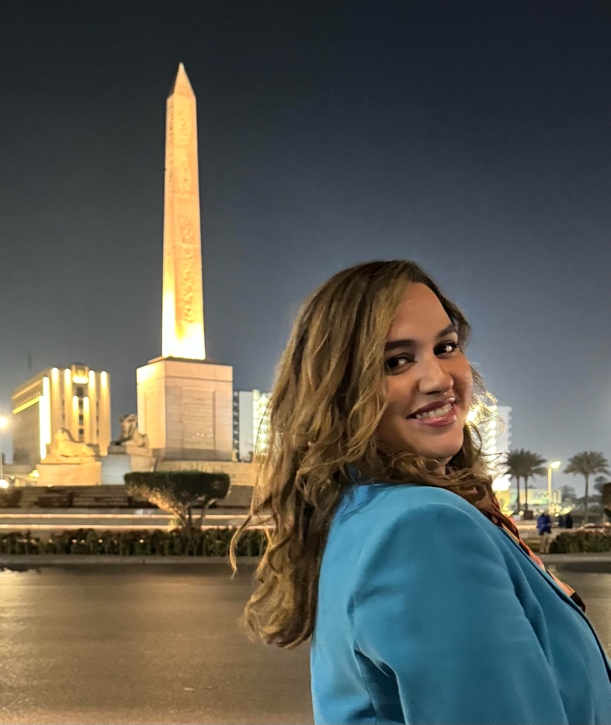
Elisa Barbero Valderrama
Born in Spain in 1995, Elisa Barbero Valderrama is a doctoral candidate in translation studies at the Pablo de Olavide University in Seville, where she belongs to the “Historia de la Globalización” research group. Her thesis examines Coptic personal-status law in Egypt from the perspective of legal translation from Arabic into Spanish.
She has carried out several research stays in Egypt, at Cairo University and Ain Shams University, and has been a Spanish-language lecturer at the University of Szeged (Hungary) since October 2025. She received the “Francisca de Nebrija” award (University of Alcalá, 2022) for her work on interpreting for non-Spanish-speaking women who are victims of human trafficking.
She took part in the summer school “Citizenship and Religious Pluralism” organised in July 2025 by the Anawati Chair at the Dominican Institute for Oriental Studies (IDEO, Cairo), and is a member of the Pluriel-affiliated “Citizenship and Religious Pluralism” research group that emerged from that gathering.
Resources related to Linguistics
article
The grammar of sacred violence: A critical discourse analysis of radical Islamist writings
- Mohamed-Ali Mostfa
This article offers a discursive analysis of two contemporary Islamist texts that present violence not as a deviation from religious normativity, but as its necessary, even redemptive expression. I...
videos
The Foundations of Arabic Grammatical Theory
Cairo. In a lecture delivered in Arabic on Saturday, January 25, 2025, at the Dominican Institute for Oriental Studies (IDEO) in Cairo, Professor Ramzi Baalbaki, holder of the Chair of Arabic...
article
The term “dahr” (fate) in the Arabic language and its literature
- Paolo Branca
It is obviously not possible to examine the entire Arab literary production: we will therefore start from the many examples of pre-Islamic verses to dwell then over the centuries on the repropositi...
article
Making religion online: the case of Islam
- Mohamed-Ali Mostfa
Islam in the digital age is becoming an inescapable reality in the lives of believers, thus introducing a new modality in the understanding of Islamic faith. From now on, the sacred text, rituals, ...
article
From Islamic Reference to Conservative Pragmatism – The Sinuous Paths of the Moroccan JDP Discourse
- Mohamed-Ali Mostfa
"The relationship between the political and religious fields in Morocco is generally based on tactical choices and pragmatic issues, often far from simple ideological orientations. In this context,...
article
Religious Radicalism. The Challenges of an Ill-Defined Concept in Europe
- Mohamed-Ali Mostfa
Ali Mostfa, professor of linguistics and discourse analysis at the Catholic University of Lyon, analyses the semantic shifts about the notion of religious radicalism, particularly since the Septemb...
videos
Otherness And Spatial Dimension In The Arabic Language And Culture
- Mohamed-Ali Mostfa
Etymologically, the noun âkhar from the verb âkhara, rather draws the action of postponing, أَخَّرَ العَمَلَ, or temporarily deprogramming an action. al-âkhar on some other hand does not establish ...
videos
Unity of God and unity in God – a possible perspective and way of dialogue between the believers?
- Vanessa Breidy
A shῑ‘ῑ perspective of dialogue developed by D. Mohammad Ali Shomali. Talking about unity between believers and calling them to act upon it is not new in Islam. The Qur’ān and the early history o...