


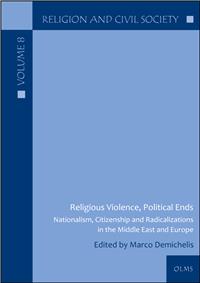
Religious Violence, Political Ends
Religious violence due to political reasons has been a common practice since ancient times: The massacres of early Christian communities, carried out by the Roman Empire, were rapidly replaced by equally harsh measures against non-Christian believers, being accused of abominable and polytheistic practises. The advent of the modern age, the homogenization of the religious sphere for political-economic ends, the annihilation of any kind of heresy and the emergence of Protestantism, Calvinism and Anglicanism restructured the conceptualization of the Western European States emphasizing the adage “one kingdom, with one religion and one nation”.
The end of the religious wars (1648), the Westphalian sovereignty and the cuius regio, eius religio had an impact on the formation of Europe and other regions, the Franco-British colonialism imposed the same system on the entire Middle Eastern and Islamic World.
This volume thoroughly examines the usage of inter-religious violence, religious sectarianism and Islamophobia on a theoretical basis, linked with “Clashes of Civilizations” and “Religious Nationalism”, and describes them as manifestations of precise political ends, aiming to preserve fragmentation and warlike states in the East as well as fear and prejudices in the West.
http://www.olms.de/search/Detail.aspx?pr=2009584
Religious violence due to political reasons has been a common practice since ancient times: The massacres of early Christian communities, carried out by the Roman Empire, were rapidly replaced by equally harsh measures against non-Christian believers, being accused of abominable and polytheistic practises. The advent of the modern age, the homogenization of the religious sphere for political-economic ends, the annihilation of any kind of heresy and the emergence of Protestantism, Calvinism and Anglicanism restructured the conceptualization of the Western European States emphasizing the adage “one kingdom, with one religion and one nation”.
The end of the religious wars (1648), the Westphalian sovereignty and the cuius regio, eius religio had an impact on the formation of Europe and other regions, the Franco-British colonialism imposed the same system on the entire Middle Eastern and Islamic World.
This volume thoroughly examines the usage of inter-religious violence, religious sectarianism and Islamophobia on a theoretical basis, linked with “Clashes of Civilizations” and “Religious Nationalism”, and describes them as manifestations of precise political ends, aiming to preserve fragmentation and warlike states in the East as well as fear and prejudices in the West.
http://www.olms.de/search/Detail.aspx?pr=2009584