
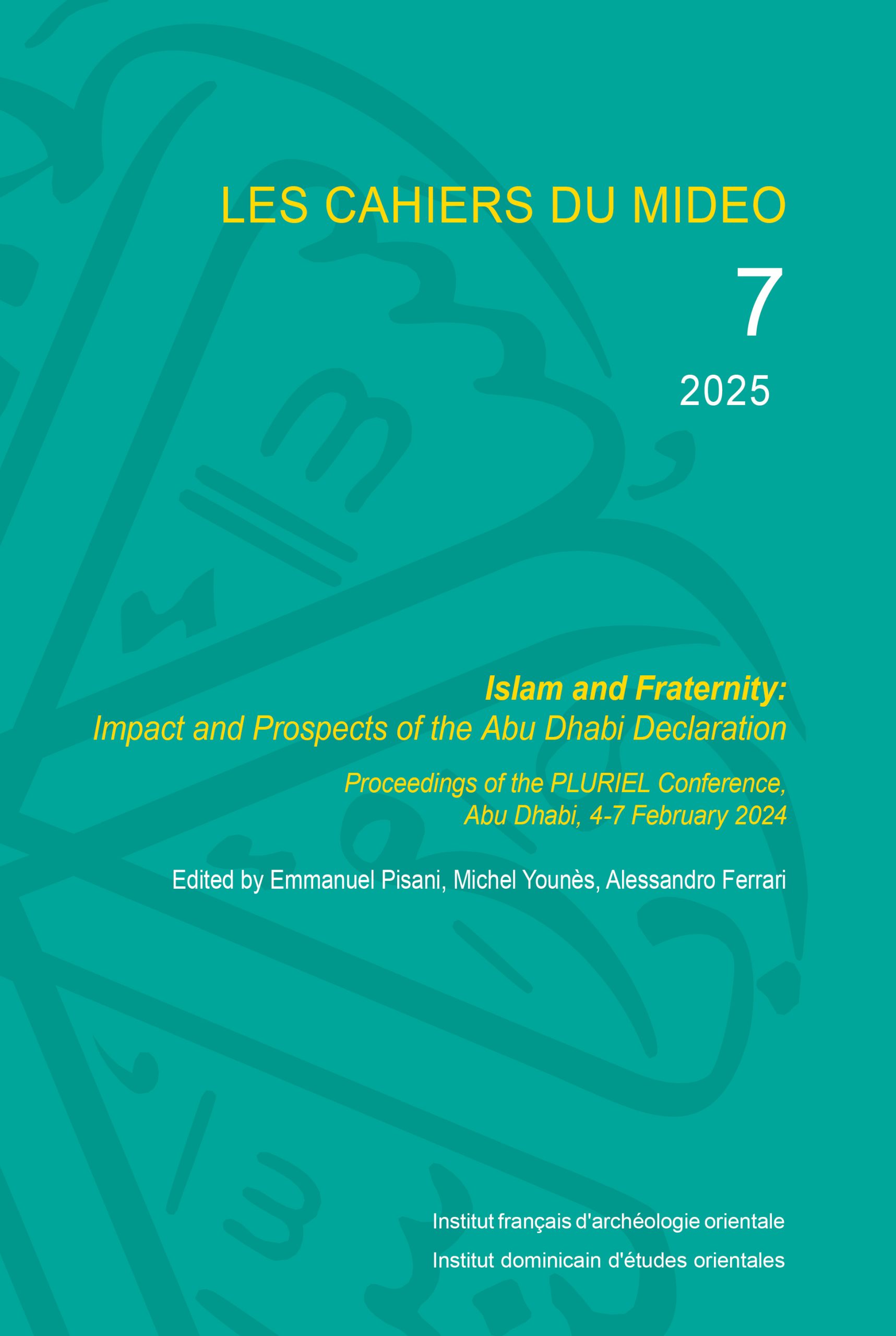
Publisher : Institut français d'archéologie orientale du Caire - Cairo

English,
Arabic,
French


Islam and Fraternity: Impact and Prospects of the Abu Dhabi Declaration
The volume dedicated to the conference “Islam and Fraternity”, held in Abu Dhabi from February 4 to 7, 2024, under the auspices of the PLURIEL network, in partnership with Trends, a research center based in the Emirates, and within the framework of the Anawati Chair, examines the reception of the Document on Human Fraternity signed in 2019 by Pope Francis and the Grand Imam of al-Azhar, Ahmad al-Tayyeb. In light of theological, philosophical, historical, and political disciplines, the authors analyze the doctrinal foundations and practical implications of a fraternity based on faith in a common Creator God.
The volume explores how this unprecedented text in the history of Muslim-Christian dialogue reshapes relationships between religious traditions through a conception of fraternity defined as an inclusive “we,” grounded in equal dignity and a consequent openness to the diversity of beliefs. It also examines the obstacles facing calls for fraternity in contexts marked by mistrust, identity-based conflicts, or exclusive interpretations of religion. By combining confessional and critical approaches, this volume offers an original contribution to the reflection on coexistence, the recognition of otherness, and the building of a society where fraternity is both a shared horizon and a collective challenge that transcends mere religious affiliation and identity.
Le volume consacré au colloque « Islam et fraternité » tenu à Abu Dhabi les 4-7 février 2024, sous l’égide du réseau PLURIEL, en partenariat avec Trends, centre de recherche basé aux Émirats, et dans le cadre de la Chaire Anawati, interroge la réception du Document sur la fraternité humaine signé en 2019 par le pape François et le Grand Imam d’al-Azhar, Ahmad al-Tayyeb. À la lumière des disciplines théologiques, philosophiques, historiques et politiques, les auteurs analysent les fondements doctrinaux et les implications pratiques d’une fraternité fondée sur la foi en un Dieu créateur commun.
Le volume rend compte de la manière dont ce texte, sans précédent dans l’histoire du dialogue islamo-chrétien, reconfigure les relations entre traditions religieuses à partir d’une fraternité définie comme un « nous » inclusif, sur la base d’une égale dignité et d’une ouverture conséquente à la diversité des croyances. Y sont également examinés les obstacles que rencontrent les appels à la fraternité dans des contextes marqués par la méfiance, les conflits identitaires ou les lectures exclusives du religieux. En croisant les approches confessionnelles et critiques, ce volume offre une contribution originale à la réflexion sur la coexistence, la reconnaissance de l’altérité, et la construction d’une société où la fraternité constitue à la fois un horizon et un enjeu commun au-delà de la seule appartenance et identité religieuse.
يتناول هذا المجلد أعمال الندوة المعنونة «الإسلام والأخوة» التي انعقدت في أبو ظبي في الفترة من 4 إلى 7 فبراير 2024، تحت رعاية شبكة PLURIEL، وبالشراكة مع مركز “تريندز” للأبحاث الذي يتخذ من الإمارات مقرًا له، وفي إطار كرسي أنوّاتي. ويستعرض هذا المجلد كيفية تلقّي وثيقة “الأخوة الإنسانية” التي وقّعها في عام 2019 البابا فرنسيس وفضيلة الإمام الأكبر أحمد الطيب شيخ الأزهر.
وفي ضوء مقاربات لاهوتية وفلسفية وتاريخية وسياسية، يُحلل الكُتّاب الأسس العقائدية والتجليات العملية لفكرة الأخوة القائمة على الإيمان بإله خالق مشترك.
ويبيّن المجلد كيف أن هذا النص، غير المسبوق في تاريخ الحوار الإسلامي–المسيحي، يعيد تشكيل العلاقات بين التقاليد الدينية انطلاقًا من تصور للأخوة على أنها «نحن» جامعة، تقوم على كرامة متساوية وانفتاح فعلي على تنوّع المعتقدات.
كما يتناول العقبات التي تعترض الدعوات إلى الأخوة في سياقات تتسم بانعدام الثقة، وصراعات الهوية، أو القراءات الحصرية للدين. ومن خلال الجمع بين المقاربات الإيمانية والنقدية، يقدم هذا المجلد إسهامًا أصيلاً في التفكير في التعايش، والاعتراف بالآخر، وبناء مجتمع تكون فيه الأخوة أفقًا مشتركًا ورهانًا جامعًا يتجاوز حدود الانتماء والهوية الدينية فحسب.


 publisher's website
Resources of this researcher
Resources related to Muslim-Christian Dialogue

article
Islamic Visions of Jesus: Revelation, Prophecy, and Eschatology
- Antonio Cuciniello
Abstract Published in the collective volume Jerusalem in Memory and Eschatology: Jewish, Christian, and Muslim Visions of the Past and Future of Jerusalem, edited by Emma O'Donnell Polyakov (Blo...

article
Questions on Islamic Soteriology in Early Islam
- Jaume Flaquer Garcia
Abstract Published under the original title "Cuestiones sobre la soteriología islámica en el islam primitivo" in the collective volume Riesgos y fidelidades. Miradas teológicas para un mundo plu...

article
The Uncreated Muslim Qur’an and the Eternally Begotten Christian Logos
- Jaume Flaquer Garcia
Abstract Published under the original title "El Corán musulmán increado y el Logos cristiano eternamente engendrado" in the monographic section Logos, Agape, Sarx. Una dialógica cristiana of iss...
publication
Les Affranchis. Des dérives religieuses dans le judaïsme, le christianisme et l’islam
- Roberta Collu Moran
Les Affranchis. Des dérives religieuses dans le judaïsme, le christianisme et l’islam (Le Passeur, 2020) offers an anthropological reading of religious excesses and radicalisation within the ...

article
The First Council of Nicaea (325) and the Christian-Muslim Dialogue on God’s Unity and Trinity
- Dirk Ansorge
Abstract Published under the original title "Das erste Konzil von Nizäa (325) und der christlich-muslimische Dialog über Gottes Einheit und Dreifaltigkeit" in issue 2/2025 of CIBEDO-Beiträge, th...
article
Christian-Muslim Relations Today: Some Reflections
- David Marshall
Abstract Published as "Christian-Muslim Relations Today: Some Reflections" in a special issue of The Muslim World marking the 50th anniversary of the Duncan Black Macdonald Center (Hartford), th...
article
Ḥaydar Ibrāhīm ʿAlī, a Thinker on Multiple Fronts
- Guy-Raymond Sarkis
Abstract Ḥaydar Ibrāhīm ʿAlī, a Sudanese sociologist of religion, is a committed intellectual whose writings both arise from and respond to the challenges of his society. He calls for a liberati...

article
Literary, Semiotic and Hermeneutical Approaches to the Qur’an in the Modern Period
- Wasim Salman
Abstract In this contribution to issue 51 (Mélanges) of the journal Islamochristiana, published in Italian as Approcci letterari, semiotici ed ermeneutici al Corano nel periodo moderno, Wasim Sa...