Benjamin Latouche

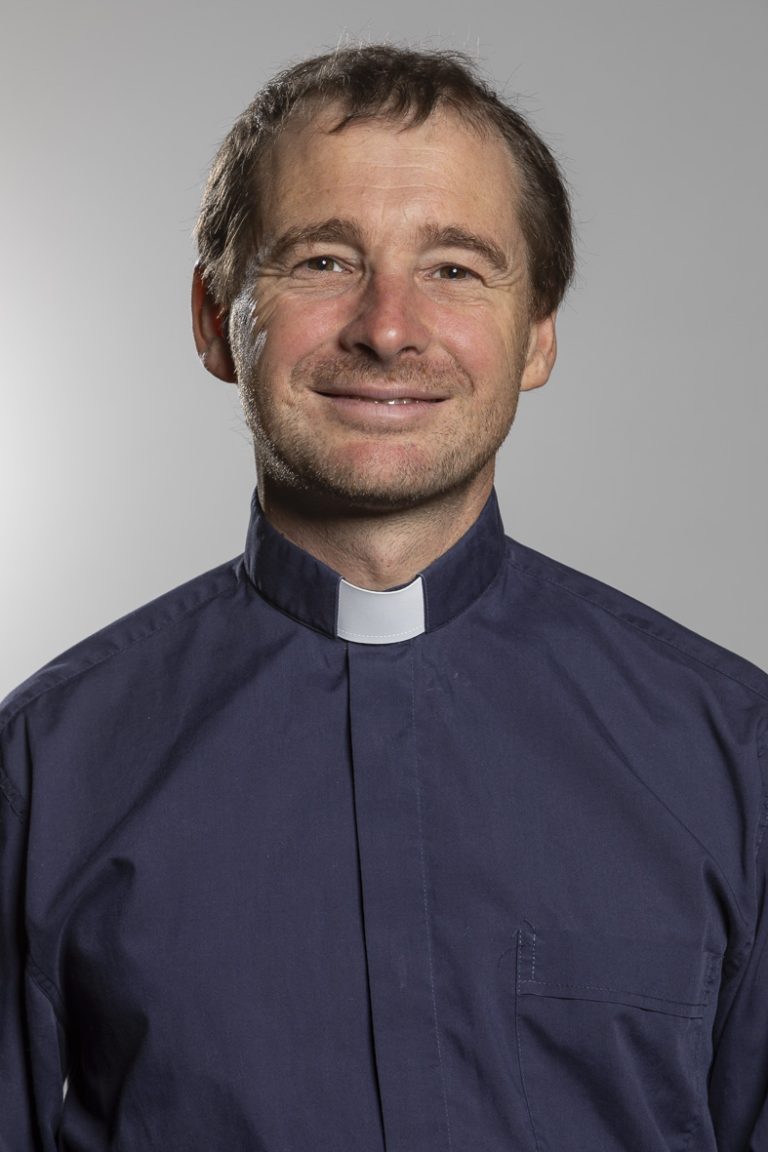
Born in 1982 in France, Benjamin Latouche is a Catholic priest and researcher, member of the Islamology laboratory at the Center for the Study of Cultures and Religions (CECR) at the Catholic University of Lyon.

After obtaining a Master’s degree in “Social Development Strategies” from Lille in 2006, he continued his theological studies at the Catholic University of Lyon, where he earned a Master’s degree in 2019, as well as a University Diploma in “Religion, Religious Freedom, and Secularism.”

His research primarily focuses on local Islamic authority figures in France, a subject on which he contributed to the collective work “Authority in Islam, What Regulation?” (Peuple Libre, 2023). He is also interested in interreligious dialogue, as evidenced by his work on the Ismerie Mission and his article “The Pursuit of Common Good, a Resource for Islamic-Christian Dialogue” (Chemins de dialogue, 2020).

Alongside his research activities, he has served as parish priest of Saint-Vincent de l’Hermitage since 2021 and co-directs the diocesan formation in Valence. He regularly participates in international conferences, notably at the Pluriel congress “Islam and Fraternity” in Abu Dhabi (2024).

His scientific approach is characterized by a transdisciplinary methodology, combining Christian theology and Islamic-Christian dialogue, with a particular interest in Catholic Social Teaching and questions of secularism.

Resources related toMuslim-Christian Dialogue

article

Kenneth Cragg and the Event of the Qur’an

  • Timo Güzelmansur

Article by Timo Güzelmansur published under the title Kenneth Cragg und das Ereignis des Koran on the theological portal feinschwarz.net (12 June 2026, open access). Timo Güzelmansur presents the A...

Le pape Léon XIV présente l'encyclique Magnifica Humanitas, Salle du Synode, Vatican, 25 mai 2026

article

Leo XIV’s encyclical Magnifica Humanitas and the Pluriel working group on AI-assisted interreligious dialogue

  • Wael Saleh

Text by Wael Saleh, researcher at the Université du Québec à Montréal (UQAM) and member of the Pluriel coordination committee. The simultaneous appearance of Leo XIV's encyclical Magnifica Human...

publication

The Recognition of a Hummingbird. Essays on Interreligious Dialogue and Missionary Work (2007-2025)

  • Rémi Caucanas

Published in May 2026 by PISAI (Pontifical Institute for Arabic and Islamic Studies, Rome), this collection brings together the essays of Rémi Caucanas on interreligious dialogue and missionary wor...

videos

From Lavigerie to PISAI: The Institutional History of the Missionaries of Africa’s Engagement with Islam

Delivered on 21 May 2026 at the Pontifical Institute for Arabic and Islamic Studies (PISAI) in Rome, this lecture opens the series of conferences marking the institute's centenary (1926-2026). Fr. ...

videos

Interreligious Dialogue and Ethnic Nationalisms in the Balkans

At the invitation of PISAI (Pontifical Institute for Arabic and Islamic Studies, Rome) and Georgetown University, Ahmet Alibašić, professor of Islamic civilization at the Faculty of Islamic Studies...

publication

For a Christian Theology of Religions

  • Michel Younès

Faced with contemporary religious diversity, how can Christian theology make sense of the place that other religions occupy in God’s design? Michel Younès examines the three traditional ̶...

publication

Intercultural Theology

  • Jean Patrick Nkolo Fanga

Because every theology is culturally situated, Christian theology is inevitably multicultural. Yet one step remains to be taken: to become intercultural. Crossing languages, contexts, origins, ages...

article

Bells and Muezzin in Harmony: Dialogue with Islam as a Spiritual Responsibility

  • Timo Güzelmansur

Article by Timo Güzelmansur published under the title Glocken und Muezzin im Einklang. Der Dialog mit dem Islam als geistliche Verantwortung in Herder Korrespondenz (special issue devoted to Pope L...