


Julio Martinez
Born in 1964 in Vigo, Spain, Julio L. Martínez, s.j., is full professor (catedrático) of moral theology at the Universidad Pontificia Comillas (Madrid), of which he was rector from 2012 to 2021.
His research addresses social moral theology, religious freedom and interreligious dialogue in Europe, as well as religion in public life, religion and politics, and contemporary migration.
Having joined the Society of Jesus in 1982 and been ordained a priest in 1995, he holds a doctorate in theology from the Universidad Pontificia Comillas (2000), a licentiate in theological ethics from the Weston School of Theology (Cambridge, USA, 1996) and a licentiate in philosophy from Comillas (1989). He has supervised seven doctoral theses and taught across Europe and the Americas; in Argentina he was for years a visiting professor at the Faculties of Theology and Philosophy of San Miguel, of which Pope Francis was rector.
He served as director of the Chair of Bioethics (2002-2004), director of the University Institute for Migration Studies (2004-2007) and vice-rector for research, development and innovation (2009-2012) at the Universidad Pontificia Comillas. In 2024, he was appointed consultant to the Biblioteca de Autores Cristianos (BAC).
Resources of this researcher
-
videos
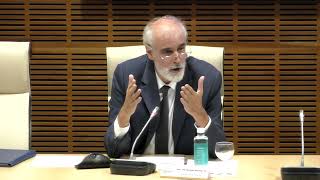
The Theological Foundations of Dialogue, by Julio L. Martínez
- Julio Martinez
On 2 October 2024, at the Universidad Pontificia Comillas (Madrid), Julio L. Martínez, s.j., professor of moral theology, delivered this lecture on the theological foundations of dialogue, as part ...
-
publication
Citizenship, migration and religion: an ethical dialogue based on the Christian faith
- Julio Martinez
Migration is undoubtedly one of the most obvious and urgent realities we encounter. It is true that societies are becoming increasingly multicultural. To deal with this situation, it is necessary t...
-
publication
Religious Freedom and Human Dignity: Catholic Keys to a Major Connection
- Julio Martinez
In this book (San Pablo / Universidad Pontificia Comillas, 2009), Julio L. Martínez, s.j., examines the connection between religious freedom and human dignity in the light of the conciliar declarat...
Resources related to Freedom of Religion
publication
Religious Freedom in Italy. An Unfinished Path (1848-2024)
- Alessandro Ferrari
Published under the original title La libertà religiosa in Italia. Un percorso incompiuto (1848-2024), this synthesis by Alessandro Ferrari, professor of ecclesiastical law and comparative religiou...

videos
From regulating religious sound to transforming it into light: public, legal and architectural debates on the adhān
Paper presented at the fifth international congress of the University Platform for Research on Islam (Pluriel), held in Cordoba from 10 to 14 February 2026 on the theme "Ethics and Aesthetics in Is...
article
Religious minorities and spiritual assistance. Reflections on the project “Atlas of religious or belief minority rights” in the European Union
- Ilaria Valenzi
Abstract Developed within the multilevel system of legal sources, the category of "religious minority" takes on particular significance within the European Union, where a shared system of protectio...
article
“Inclusive Citizenship, the Right to a Place of Worship and Everyday Peace”, by Antonio Angelucci
- Antonio Angelucci
In an article published in the Italian journal Coscienza e Libertà (no. 69, 2025), Antonio Angelucci, associate professor of law and religion at the University of Insubria, examines the connection ...
article
Public order and religious family rights. Sustainability and limits of an evolving legal relationship
- Ilaria Valenzi
Abstract The public-order clause, which safeguards the fundamental principles of the legal order, is today tested by the circulation of family models rooted in religious legal systems. Ilaria Valen...

videos
Freedom of conscience, a contested yet resilient right
- Dominique Avon
Rome. In a conference given on November 28, 2024, at the Pontifical Institute for Arabic and Islamic Studies, Professor Dominique Avon from the École Pratique des Hautes Études in Paris traced the ...
publication
Speaking freely in Islam
- Hamadi Redissi
What is the Islamic doctrine of blasphemy, insult to God, religion and the Prophet? What about the prohibition of figurative representation of Muhammad? Can one openly believe or abjure in Islam? T...
publication
Religious minorities between the Mediterranean shores: a study of the status of religious minorities in the Mediterranean context (REMiMEsO) – Final Report
- Alessandro Ferrari
The REMiMESo project, led by Ilaria Valenzi and supported by the Italian Ministry of Foreign Affairs, explores the situation of religious minorities in five Mediterranean countries: Israel, Morocco...