
10 November 2026
40 Years after the Assisi Meeting: How Can Religions Serve Peace?
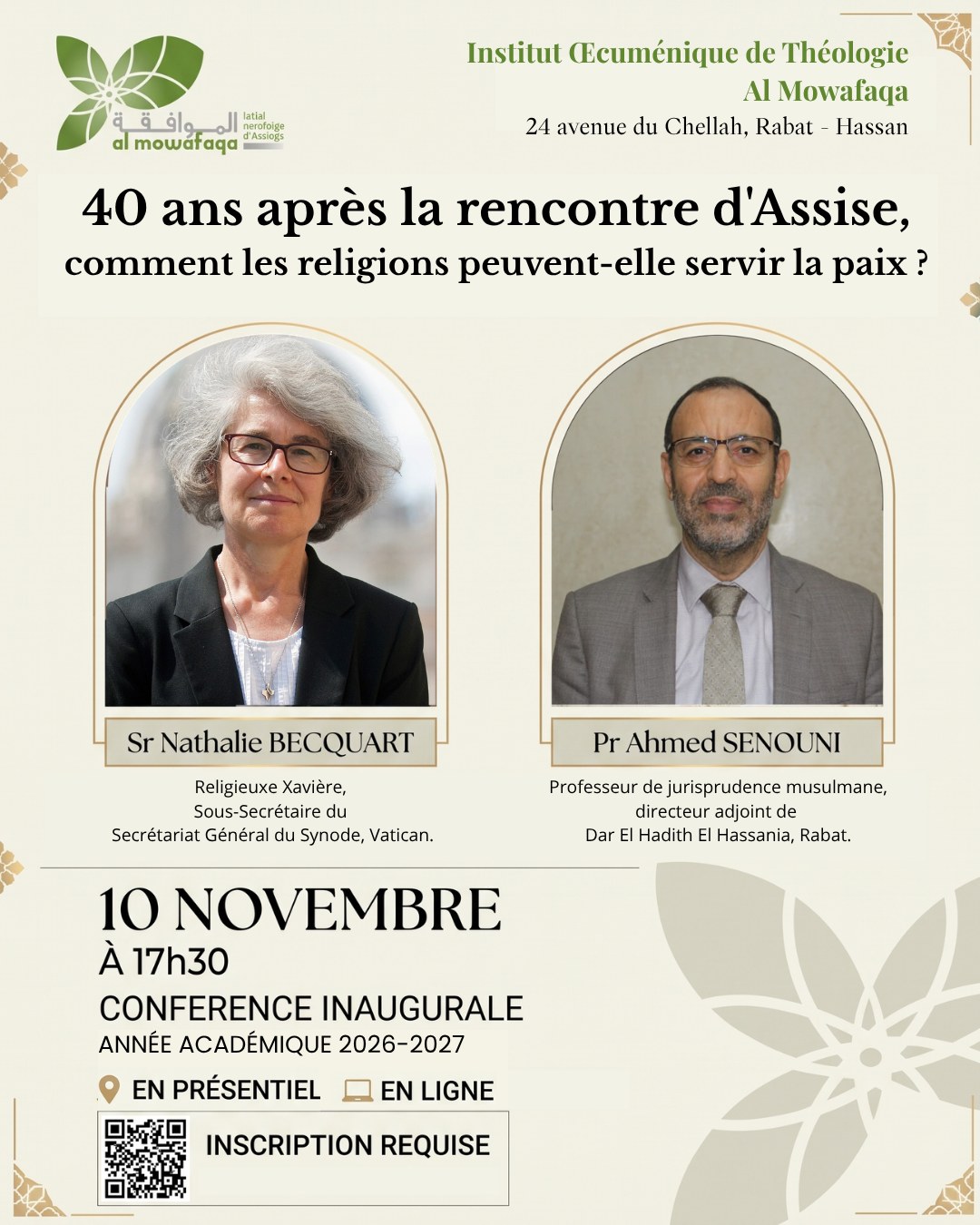
On Tuesday 10 November 2026, the Al Mowafaqa Ecumenical Institute of Theology (Rabat), directed by Jean Patrick Nkolo Fanga, opens its 2026–2027 academic year with an inaugural lecture given by two speakers, one Christian and one Muslim, devoted to the legacy of the Assisi meeting.
On 27 October 1986, at the invitation of Pope John Paul II, representatives of the world’s major religious traditions gathered in Assisi for the first time to pray and bear witness together for peace. Forty years later, as new geopolitical and identity-based fractures run through the world, the lecture considers what remains of this momentum today: what influence has the meeting had on religious and political leaders, and what spiritual, theological and legal resources do Islam and Christianity have to consolidate a lasting culture of peace and justice?
Speakers:
- Nathalie Becquart, a religious sister of the Xavières, Undersecretary of the General Secretariat of the Synod (Vatican);
- Ahmed Senouni, professor of Islamic jurisprudence, deputy director of Dar El Hadith El Hassania (Rabat).
- Date: Tuesday 10 November 2026, 17:30 (Rabat time);
- Venue: Al Mowafaqa Institute, 24 avenue du Chellah, Rabat-Hassan (Morocco);
- Format: hybrid, on site (subject to available seats) and online via Zoom;
- Registration: required, via the event page; information: evenementiel@almowafaqa.com.
Le mardi 10 novembre 2026, l’Institut œcuménique de théologie Al Mowafaqa (Rabat), dirigé par Jean Patrick Nkolo Fanga, ouvre son année académique 2026-2027 par une conférence inaugurale à deux voix, chrétienne et musulmane, consacrée à l’héritage de la rencontre d’Assise.
Le 27 octobre 1986, à l’invitation du pape Jean-Paul II, les représentants des principales traditions religieuses du monde se réunissaient pour la première fois à Assise afin de prier et de témoigner ensemble en faveur de la paix. Quarante ans plus tard, alors que de nouvelles fractures géopolitiques et identitaires traversent le monde, la conférence interroge la portée actuelle de cette dynamique : quelle influence la rencontre a-t-elle eue sur les responsables religieux et politiques, et de quelles ressources spirituelles, théologiques et juridiques l’islam et le christianisme disposent-ils pour consolider une culture durable de la paix et de la justice ?
Interviennent :
- Nathalie Becquart, religieuse xavière, sous-secrétaire du Secrétariat général du Synode (Vatican) ;
- Ahmed Senouni, professeur de jurisprudence musulmane, directeur adjoint de Dar El Hadith El Hassania (Rabat).
- Date : mardi 10 novembre 2026, à 17h30 (heure de Rabat) ;
- Lieu : Institut Al Mowafaqa, 24 avenue du Chellah, Rabat-Hassan (Maroc) ;
- Modalité : hybride, sur place dans la limite des places disponibles et en ligne sur Zoom ;
- Inscription : requise, depuis la page de la conférence ; renseignements à l’adresse evenementiel@almowafaqa.com.
يفتتح معهد الموافقة المسكوني للاهوت في الرباط، الذي يديره جان باتريك نكولو فانغا، سنته الأكاديمية 2026-2027 يوم الثلاثاء 10 نوفمبر/تشرين الثاني 2026 بمحاضرة افتتاحية يتقاسمها صوتان، مسيحي ومسلم، وتتناول إرث لقاء أسيزي.
ففي 27 أكتوبر/تشرين الأول 1986، وبدعوة من البابا يوحنا بولس الثاني، اجتمع ممثلو كبرى التقاليد الدينية في العالم للمرة الأولى في أسيزي ليصلّوا معاً ويشهدوا للسلام. أمّا اليوم، وقد عادت انقسامات جيوسياسية وهوياتية جديدة تشقّ العالم، فإنّ المحاضرة تتساءل عمّا بقي من تلك الدينامية: ما الأثر الذي تركه هذا اللقاء في القادة الدينيين والسياسيين؟ وما الموارد الروحية واللاهوتية والقانونية التي يملكها الإسلام والمسيحية لترسيخ ثقافة دائمة للسلام والعدل؟
ويتناوب على الكلمة فيها:
- ناتالي بيكار، الراهبة الكسافيرية ووكيلة الأمانة العامة لسينودس الأساقفة في الفاتيكان؛
- أحمد السنوني، أستاذ الفقه الإسلامي ونائب مدير دار الحديث الحسنية في الرباط.
- التاريخ: الثلاثاء 10 نوفمبر/تشرين الثاني 2026، الساعة 17:30 بتوقيت الرباط؛
- المكان: معهد الموافقة، 24 شارع شالة، حي حسان، الرباط (المغرب)؛
- الصيغة: حضورياً في المعهد في حدود المقاعد المتاحة، وعن بُعد عبر منصة زوم؛
- التسجيل: إلزامي عبر صفحة المحاضرة؛ وللاستعلام: evenementiel@almowafaqa.com.


Resources related to Muslim-Christian Dialogue

article
Islamic Visions of Jesus: Revelation, Prophecy, and Eschatology
- Antonio Cuciniello
Abstract Published in the collective volume Jerusalem in Memory and Eschatology: Jewish, Christian, and Muslim Visions of the Past and Future of Jerusalem, edited by Emma O'Donnell Polyakov (Blo...

article
Questions on Islamic Soteriology in Early Islam
- Jaume Flaquer Garcia
Abstract Published under the original title "Cuestiones sobre la soteriología islámica en el islam primitivo" in the collective volume Riesgos y fidelidades. Miradas teológicas para un mundo plu...

article
The Uncreated Muslim Qur’an and the Eternally Begotten Christian Logos
- Jaume Flaquer Garcia
Abstract Published under the original title "El Corán musulmán increado y el Logos cristiano eternamente engendrado" in the monographic section Logos, Agape, Sarx. Una dialógica cristiana of iss...

article
The First Council of Nicaea (325) and the Christian-Muslim Dialogue on God’s Unity and Trinity
- Dirk Ansorge
Abstract Published under the original title "Das erste Konzil von Nizäa (325) und der christlich-muslimische Dialog über Gottes Einheit und Dreifaltigkeit" in issue 2/2025 of CIBEDO-Beiträge, th...
article
Christian-Muslim Relations Today: Some Reflections
- David Marshall
Abstract Published as "Christian-Muslim Relations Today: Some Reflections" in a special issue of The Muslim World marking the 50th anniversary of the Duncan Black Macdonald Center (Hartford), th...
article
Ḥaydar Ibrāhīm ʿAlī, a Thinker on Multiple Fronts
- Guy-Raymond Sarkis
Abstract Ḥaydar Ibrāhīm ʿAlī, a Sudanese sociologist of religion, is a committed intellectual whose writings both arise from and respond to the challenges of his society. He calls for a liberati...

article
Literary, Semiotic and Hermeneutical Approaches to the Qur’an in the Modern Period
- Wasim Salman
Abstract In this contribution to issue 51 (Mélanges) of the journal Islamochristiana, published in Italian as Approcci letterari, semiotici ed ermeneutici al Corano nel periodo moderno, Wasim Sa...
videos
A Muslim Reads St Paul: Recording of the Symposium on Shabbir Akhtar Now Online
- David Marshall
- Gabriel Said Reynolds
On 9 September 2026, the Institute for the Study of Religion in the Middle East (ISRME) and the Pontifical Institute for Arabic and Islamic Studies (PISAI, Rome) held an online symposium on The New...