
Cosmic and Animal Piety in Islam: Everything Glorifies God
Edited by Walid Ghali, Guillaume de Vaulx d’Arcy, Asmaa El Maaroufi and Nicolas Payen, this collective volume examines the concept of praise (tasbīḥ) in Islam, in its human and nonhuman expressions.
Starting from the Qur’anic verse according to which the sun, the moon, the stars, the mountains, the trees and the beasts prostrate before God (Q 22:18), the book offers an original perspective on animal studies, Islam and the extensions of religion. It engages with ideas and narratives in which nonhuman creatures, both animate and inanimate, are portrayed as the ideal worshippers of God, and argues that the piety of animals and of the whole cosmos not only represents an ideal form of worship but also serves as a model for more fallible human piety.
The volume provides a census and explanation of the Qur’anic verses on cosmic piety, explores case studies on dogs and cats in hadith literature and Muslim culture, reveals the bond between zoology and theology in Islam and draws on hermeneutic tools from Hebrew and Syriac literature.
Three Pluriel researchers contribute to it: Geneviève Gobillot (“Animals in the Qur’an: Symbols, Representations and Models of Piety”), Pierre Lory (“Animal Piety, Angelic Piety and Human Impiety”) and Florence Ollivry (“The Natural World as a Medium of Otherworldly Contemplation and Animals as Figures of Piety in Ibn Barraǧān of Seville”). Guillaume de Vaulx d’Arcy also writes two chapters, on cosmic worship in the Qur’an and on animals as “Muslims” in the Epistles of the Brethren of Purity.
Paru sous le titre Cosmic and Animal Piety in Islam: Everything Glorifies God, cet ouvrage collectif, dirigé par Walid Ghali, Guillaume de Vaulx d’Arcy, Asmaa El Maaroufi et Nicolas Payen, étudie la notion de louange (tasbīḥ) en islam, dans ses expressions humaines et non humaines.
Partant du verset coranique selon lequel le soleil, la lune, les étoiles, les montagnes, les arbres et les animaux se prosternent devant Dieu (Coran 22, 18), le livre propose un regard original sur les études animales, l’islam et les prolongements du religieux. Il s’attache aux idées et aux récits dans lesquels les créatures non humaines, animées comme inanimées, apparaissent comme les adoratrices idéales de Dieu, et soutient que la piété des animaux et du cosmos tout entier n’est pas seulement une forme idéale d’adoration : elle sert aussi de modèle à la piété humaine, plus faillible.
Le volume recense et commente les versets coraniques consacrés à la piété cosmique, s’appuie sur des études de cas consacrées aux chiens et aux chats dans la littérature du hadith et la culture musulmane, met au jour le lien entre zoologie et théologie en islam et mobilise des outils herméneutiques issus des littératures hébraïque et syriaque.
Trois chercheurs de Pluriel y contribuent : Geneviève Gobillot (« Les animaux dans le Coran : symboles, représentations et modèles de piété »), Pierre Lory (« Piété animale, piété angélique et impiété humaine ») et Florence Ollivry (« Le monde naturel comme support de la contemplation de l’au-delà et les animaux comme figures de piété chez Ibn Barraǧān de Séville »). Guillaume de Vaulx d’Arcy y signe aussi deux chapitres, sur le culte cosmique dans le Coran et sur les animaux « musulmans » des Épîtres des Frères de la pureté.
صدر هذا الكتاب الجماعي بالإنكليزية تحت العنوان الآتي:
Cosmic and Animal Piety in Islam: Everything Glorifies God
وقد أشرف عليه وليد غالي وغيوم دو فو دارسي وأسماء المعروفي ونيكولا باين، وهو يدرس مفهوم التسبيح في الإسلام، بتعبيراته البشرية وغير البشرية.
وينطلق الكتاب من الآية القرآنية: «ألم تر أن الله يسجد له من في السماوات ومن في الأرض والشمس والقمر والنجوم والجبال والشجر والدواب وكثير من الناس» (الحج: 18)، ليقدّم نظرة جديدة إلى دراسات الحيوان والإسلام وامتدادات الدين. فيتناول الأفكار والسرديات التي تظهر فيها المخلوقات غير البشرية، الحيّة منها والجامدة، في صورة العابد المثالي لله، ويرى أنّ تقوى الحيوانات والكون كلّه ليست صورة مثالية للعبادة فحسب، بل هي أيضاً نموذج لتقوى الإنسان الأكثر عرضة للزلل.
ويحصي الكتاب الآيات القرآنية المتعلّقة بالتقوى الكونية ويشرحها، ويدرس حالات تخصّ الكلاب والقطط في أدب الحديث وفي الثقافة الإسلامية، ويكشف الصلة بين علم الحيوان والإلهيات في الإسلام، ويستعين بأدوات تأويلية من الأدبين العبري والسرياني.
ويسهم فيه ثلاثة من باحثي بلوريال: جينيفييف غابيو («الحيوانات في القرآن: رموز وتمثّلات ونماذج للتقوى»)، وبيير لوري («تقوى الحيوان وتقوى الملائكة وعصيان الإنسان»)، وفلورنس أوليفري («العالم الطبيعي سبيلاً إلى تأمّل الآخرة والحيوانات صوراً للتقوى عند ابن برّجان الإشبيلي»). ويوقّع غيوم دو فو دارسي أيضاً فصلين، عن عبادة الكون في القرآن وعن «إسلام» الحيوانات في رسائل إخوان الصفا.
By the same authors on Pluriel
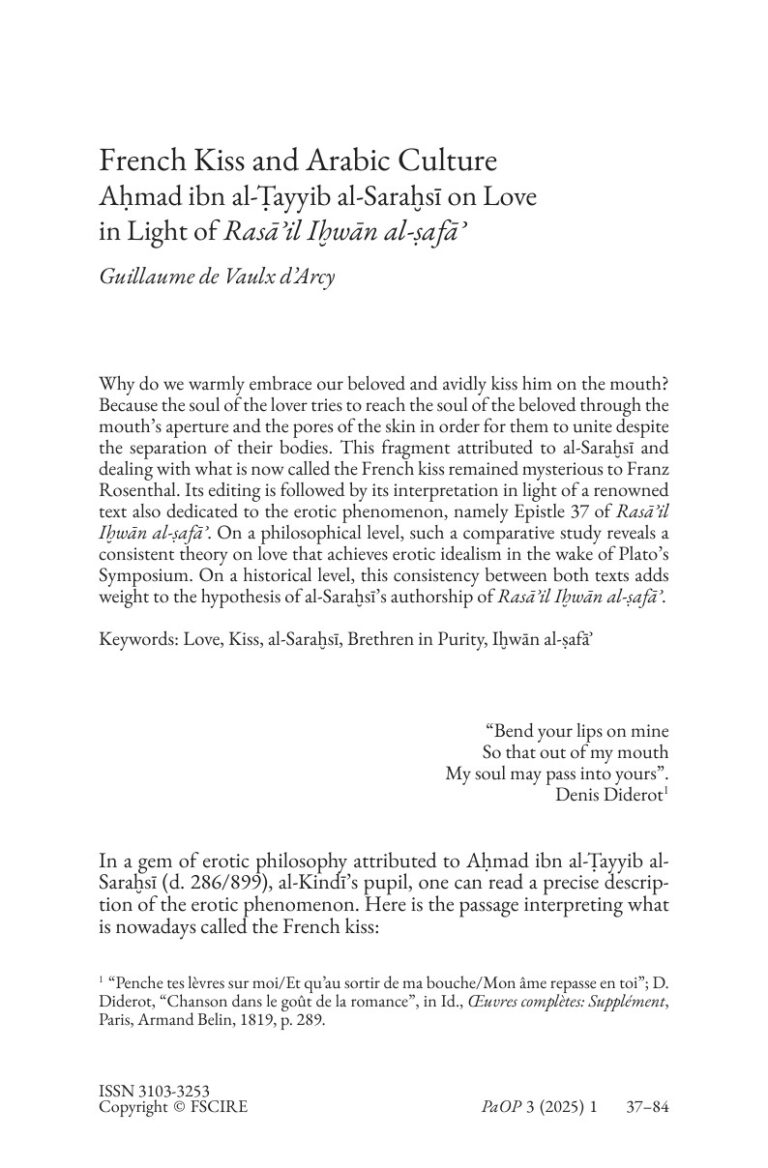 French Kiss and Arabic Culture: Aḥmad ibn al-Ṭayyib al-Saraḫsī on Love in Light of Rasāʾil Iḫwān al-ṣafāʾ
Guillaume de Vaulx d’Arcy Abstract Published in the Palermo Occasional Papers of the Foundation for Religious Sciences (FSCIRE) (vol. 3, no. 1, 2025, pp. 37-84), this article by…
 The Figure of Jesus in Muslim Mysticism, by Pierre Lory
Pierre Lory Lecture given by Pierre Lory (Directeur d'études émérite at EPHE-PSL, Chair of "Muslim Mysticism") as part of the Théologies en dialogue Chair of the…
 Islamochristiana Journal 49 (2024): “Maurice Borrmans and Mohamed Talbi: From Friendship to Rupture”
David Marshall · Diego Sarrió Cucarella · Rémi Caucanas · Michel Younès · Geneviève Gobillot · Florence Javel · Yosra Garmi · Tobias Specker The title of this issue, “Maurice Borrmans and Mohamed Talbi: From Friendship to Rupture,” was suggested to us by a collection of articles that…
 Authority according to the Qur’an and the authority of the Qur’an: from model to realisation
Geneviève Gobillot Conference « Religious Authority in Islam », organised by the Centre for the Study of Cultures and Religions and the Research Unit of the…
 Al-Tirmidhî and mystical mediation
Geneviève Gobillot Lecture given on 14 October 2021 at the Catholic University of Lyon during the conference « Radicalisation leading to violence in the name of…
Related resources: « Islam Studies »
 Photographing Ordinary Islam
Guillaume Chatagny What does Islam concretely look like within a Muslim association? This is the question addressed by sociologist Guillaume Chatagny in this book, based on…
 Islam and Muslims. Doctrines, Schools of Thought, and Current Trends
Michel Younès Publication date: April 16, 2026. Islam, as a historical, religious, and civilizational reality, is difficult to define. It can be perceived as a form…
 Canon and Censorship in Islamic Intellectual History
Amir Dziri Published in De Gruyter’s series “Islam: Thought, Culture, and Society” (vol. 16, 2026), this collective volume is edited by Mohammad Gharaibeh and Bacem Dziri…
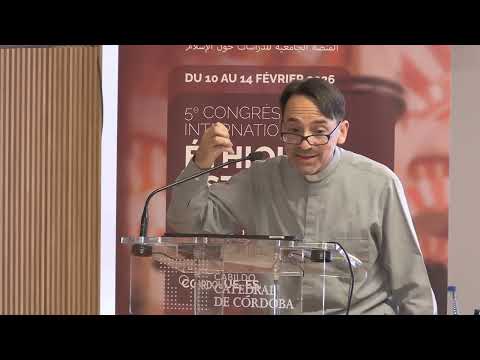 Ethics and aesthetics in the art galleries of Zamalek
Paper presented at the fifth international congress of the University Platform for Research on Islam (Pluriel), held in Cordoba from 10 to 14 February…
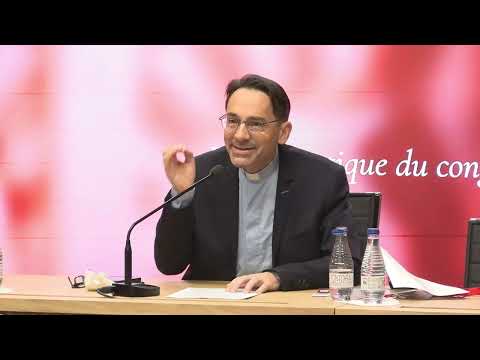 The theme of the Cordoba congress
Emmanuel Pisani An opening presentation of the stakes of the 5th international congress of the University Platform for Research on Islam (Pluriel), held in Cordoba from…
 Between Threat and Ideal: The Subjectivation of Imams
Noemi Trucco AbstractPublic debate on Muslims in Switzerland is characterized to a significant degree by issues of problematisation and securitisation. In this debate, imams have become…