
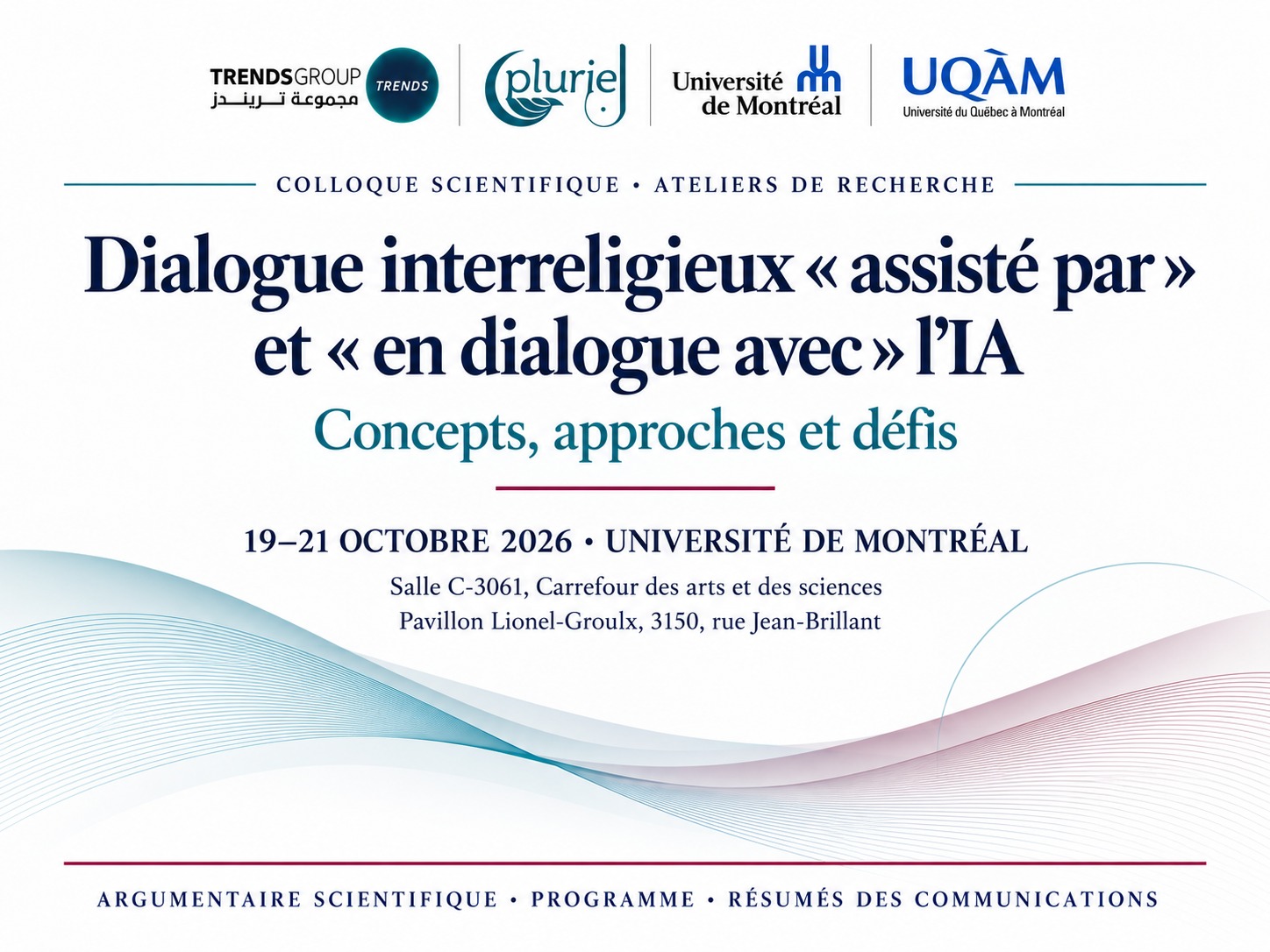
19 أكتوبر 2026 إلى 21 أكتوبر 2026
الحوار بين الأديان «بمساعدة» الذكاء الاصطناعي و«في حوار معه»: مفاهيم ومقاربات وتحديات
من الاثنين 19 إلى الأربعاء 21 أكتوبر/تشرين الأول 2026، تُنظّم مجموعة البحث «الحوار بين الأديان بمساعدة الذكاء الاصطناعي» التابعة للمنصة الجامعية للدراسات حول الإسلام (Pluriel) ومؤسسة «تريندز غلوبال»، بالتعاون مع جامعة مونتريال وجامعة كيبيك في مونتريال (UQAM)، ندوةً علمية تعقبها ورش بحثية تتناول موقع الذكاء الاصطناعي من الحوار بين الأديان. ويلتقي فيها 28 أكاديمياً يمثّلون 24 مؤسسة من 10 بلدان، من لاهوتيين وقانونيين وباحثين في العلوم الإنسانية والاجتماعية ومتخصّصين في الذكاء الاصطناعي، وافدين من أوروبا والشرق الأوسط والخليج وأميركا الشمالية.
إنّ الحقل الديني يشهد تحوّلاً عميقاً بفعل صعود الذكاء الاصطناعي التوليدي والبيئات الرقمية. فلم تعد التقنية مجرّد وسيلة لنقل المعارف أو الخطابات الدينية، بل صارت تتدخّل في إنتاج المعلومة وانتقائها وترتيبها وإعادة صياغتها، وتُسهم في نسج التمثّلات المتبادلة بين الأفراد والجماعات والتقاليد. وحين تتولّى الأنظمة تأويلَ الخطابات، واستدعاءَ المصادر، وإعادةَ صياغة المواقف، وإبرازَ وجهات النظر، فإنّها تنتقل من المساعدة إلى الوساطة، بل إلى المحاورة. وفي المقابل، تتناول الندوة إسهامَ الدراسات الدينية والفلسفة والأخلاق وممارسات الوساطة في تطوير الذكاء الاصطناعي.
ومن هنا ينبثق السؤال المحوري الذي تطرحه الندوة: «إلى أيّ حدّ يمكن الانتقال من ذكاء اصطناعي يُتصوَّر أداةً للمساندة إلى ذكاء اصطناعي وسيط، بل إلى محاور تفاعلي، بلا اختزالٍ للتعدّدية الدينية، ولا إضعافٍ لمركزية الإنسان؟»
وتتوزّع أعمال الندوة على أربعة محاور:
- الذكاء الاصطناعي وإعادة تشكيل المعرفة والخطاب وتمثّل الدين؛
- إعادة التفكير في الحوار بين الأديان في عصر الذكاء الاصطناعي: المفاهيم والفاعلية وحدود الوساطة؛
- من الاستقطاب إلى التحوّل الحواري في الفضاء الرقمي: تحليل بنية الخلاف وقياس جودة الحوار؛
- أنسنة الذكاء الاصطناعي وتخليقه وحوكمته في السياقات الدينية.
تُعقد الندوة يوم 19 أكتوبر/تشرين الأول وصباح اليوم التالي، ثم تمتدّ أعمالها عصرَ العشرين وطوال يوم الحادي والعشرين في ثلاث ورش للبحث والتجريب والتحقّق مخصّصة لـ«ديالوجيا» (Dialogia)، وهي منصّة بحثية تستكشف قدرةَ النماذج اللغوية الكبيرة (LLM) على دعم تفاعلٍ منظَّم من غير أن تحلّ محلّ الحكم البشري والمسؤولية الإنسانية. وتُقارن الورش بين التحليل البشري وأجوبة «ديالوجيا» سعياً إلى تدقيق المصادر ومعايير الجودة الحوارية وإمكانات التصحيح وإحكام الإشراف العلمي والأخلاقي.
الاثنين 19 أكتوبر/تشرين الأول: الندوة العلمية
- 8:30 استقبال المشاركين؛
- 8:45 كلمة افتتاحية للجنة العلمية؛
- 9:00 كلمة افتتاحية يلقيها جيل بيبو (جامعة مونتريال) بعنوان «الذكاء الطبيعي والذكاء الاصطناعي: الوعي والاستقلالية والفاعلية الأخلاقية على محكّ الحوار بين الأديان».
الجلسة الأولى، من 9:15 إلى 11:00
«الذكاء الاصطناعي وإعادة تشكيل المعرفة والخطاب وتمثّلات الدين». يدير الجلسة باتريس برودور.
- ميشال يونس (الجامعة الكاثوليكية في ليون، المنصة): «نحو منظور متجدّد للأنثروبولوجيات المتحاورة في عصر الذكاء الاصطناعي»؛
- جان درويال (المعهد الدومينيكي للدراسات الشرقية، IDEO، القاهرة): «إعادة النظر في البحث الببليوغرافي في الدراسات الدينية وما بين الأديان بالاستعانة بوكيل محادثة»؛
- رافائيل جورجي (المنصة): «”أيُجيب كما يُجيب الإمام؟” جدلٌ في التصميم يكشف عتبة المرجعية»؛
- أدريان دو فوشييه (مكتبة الفاتيكان الرسولية): «تغذية الذكاء الاصطناعي بالنصوص والبيانات الوصفية»؛
- وائل صالح (معهد الدراسات الدولية في مونتريال وكرسي راوول-داندوران، جامعة كيبيك في مونتريال؛ مركز تريندز للبحوث والاستشارات؛ المنصة): «إعادة التفكير في تعدّدية الإسلام المعاصر والحوار باسم الدين في عصر الذكاء الاصطناعي: مقاربة أخلاقية-أنطولوجية-إبستمولوجية»؛
- مناقشة عامة.
الجلسة الثانية، من 11:15 إلى 13:00
«إعادة التفكير في الحوار بين الأديان في عصر الذكاء الاصطناعي: المفاهيم والفاعلية وحدود الوساطة». يدير الجلسة ميشال يونس.
- رجاء سكراني (جامعة بون، المنصة): «الذكاء الاصطناعي بديلاً من الإلهي؟ بعض انعكاساته على الحوار بين الأديان»؛
- باتريس برودور (جامعة مونتريال): «هل يمكن أن يُقارَن التواصل التفاعلي الذي يقتضيه تعامل مستخدمي النماذج اللغوية الكبيرة مع منصّات الذكاء الاصطناعي التوليدي بشكلٍ جديد من أشكال الحوار، بل أن يغدو كذلك، داخل الحوار بين الرؤى الكونية أو خارجه؟»؛
- عيسى علي المنّاعي (مركز تريندز للبحوث والاستشارات): «حين يغدو الذكاء الاصطناعي وسيطاً: الموثوقية والمسؤولية والحدود في الحوار بين الأديان»؛
- آن دو لوكا (مركز ثوسيديديس، جامعة باريس بانتيون-أساس): «الحوار بين الأديان على محكّ الذكاء الاصطناعي: من وهم السيطرة إلى الجدل المثمر»؛
- أنطوني البعيني (جامعة القديس يوسف في بيروت): «أن نسكن الحوار من دون أن نسكن الإيمان: الذكاء الاصطناعي وسيطاً بين الأديان»؛
- شادي قهوجي (جامعة القديس يوسف في بيروت والجامعة الأميركية في بيروت): «من السرد إلى الوساطة: الذكاء الاصطناعي التوليدي طرفاً ثالثاً مؤوِّلاً للحوار بين الأديان في الرواية العربية المعاصرة»؛
- مناقشة عامة.
الجلسة الثالثة، من 14:00 إلى 15:45
«من الاستقطاب إلى التحوّل الحواري في العصر الرقمي: تحليل الخلاف وبناء اللقاء». يدير الجلسة إيمانويل بيساني.
- هيذر ميلر روبنز (معهد الدراسات الإسلامية والمسيحية واليهودية، ICJS، بالتيمور): «تطوير المقياس المرجعي بين الأديان ICJS 1.0: اعتبارات وخيارات منهجية»؛
- كريم كردادي (جامعة مونتريال، المنصة): «التطرّف العنيف باسم الإسلام لدى الشباب في السياق الرقمي: من الاستقطاب إلى الوقاية، أيّ إسهام للذكاء الاصطناعي؟»؛
- حمد الحوسني (مركز تريندز للبحوث والاستشارات): «من الاستقطاب الرقمي إلى التطرّف الأيديولوجي: كيف توظّف الجماعات المتطرّفة والإرهابية الذكاء الاصطناعي، وما التحدّيات الناجمة عن ذلك»؛
- أندريه ضاهر (الجامعة الأنطونية، لبنان): «من الذكاء الاصطناعي إلى الذكاء الحواري: التربية على لقاء الآخر في عالم متعدّد الأديان»؛
- رينيه حتّر (جامعة القلب الأقدس الكاثوليكية، ميلانو، المنصة): «من الإصغاء إلى اللقاء: الموسيقى المقدّسة أداةً للحوار بين الأديان في عصر الذكاء الاصطناعي»؛
- مناقشة عامة.
من 16:00 إلى 17:00، نقاش جامع
«التعدّدية، والمرجعية، والجودة الحوارية، والمصادر، والمسؤولية، والإشراف البشري». ويصل هذا النقاش بين المحاور الثلاثة الأولى، ويمدّ الجسر من التأمّل العلمي إلى الجلسة الرابعة، ثم إلى ورش التجريب والتحقّق المخصّصة لديالوجيا. ويعقّب عليه كلٌّ من سولانج لوفيفر وجان فرنسوا روسيل.
الثلاثاء 20 أكتوبر/تشرين الأول: من التأمّل العلمي إلى التصميم المشترك
الجلسة الرابعة، من 9:00 إلى 11:15
«أنسنة الذكاء الاصطناعي وتخليقه وحوكمته في السياقات الدينية». يدير الجلسة وائل صالح.
- فيولين لوماي (جامعة مونتريال): «القيم الفلسفية والدينية: الفضيلة الحامية للحركيّة الفكرية، والخطر المُكبِّل للمنعكس التقنو-سياسي الخفيّ الذي يفرضه منذ الآن اللجوء النمطي إلى الذكاء الاصطناعي»؛
- ليز لانغلوا (جامعة لافال، المرصد الدولي للآثار المجتمعية للذكاء الاصطناعي والتقنيات الرقمية، OBVIA): «الذكاء الاصطناعي: زمن الكرامة والمسؤولية»؛
- وسيم سلمان (المعهد البابوي للدراسات العربية والدراسات الإسلامية، PISAI، روما، المنصة): «الإنسانية والوساطة والمسؤولية: التفكير في الحوار بين الأديان بمساعدة الذكاء الاصطناعي في ضوء الرسالة العامة “الإنسانية الرائعة”»؛
- إيمانويل بيساني (المعهد الدومينيكي في القاهرة، المنصة): «الذكاء الاصطناعي والعلماء المسلمون: ردود فعل وتقييمات أولى في الأخلاق الإسلامية»؛
- أنطونيو أنجيلوتشي (جامعة إنسوبريا، إيطاليا، مركز البحث «الأديان والحقوق والاقتصادات في الفضاء المتوسطي»، REDESM): «مَن يكتب دستور الخوارزمية؟ ثلاثة حدود قانونية لذكاء اصطناعي ينتقل من مساعدة الحوار بين الأديان إلى التوسّط فيه»؛
- كارستن ليمان (المعهد العالي الكنسي لإعداد المعلّمين في فيينا والنمسا السفلى، جامعة فيينا): «المقاربات المتأرجحة للعاملين في الحقل الديني إزاء الذكاء الاصطناعي»؛
- هزار حيدر (جامعة كيبيك في ريموسكي، OBVIA): «حوكمة ذكاء اصطناعي وسيط في الشأن الديني: أيّ مبادئ أخلاقية، وأيّ حدود؟»؛
- زياد صالح (جامعة مونتريال): «منصة “ديالوجيا”: الحوار بين الأديان “بمساعدة” الذكاء الاصطناعي و”في حوار معه”، مفاهيم ومقاربات وتحديات»؛
- مناقشة عامة.
من 11:30 إلى 17:00، الورشة الأولى
«من النظرية إلى التطبيق: اختبار مسار الوساطة الحوارية لديالوجيا». يُشرف على تنشيطها زياد صالح ووائل صالح وعيسى علي المنّاعي. وتختبر الورشة، بعملٍ جماعي، البنيةَ المفهومية والمنهجية لديالوجيا انطلاقاً من مواقف ملموسة يتجاور فيها الحوار والخلاف والاستقطاب، ثم تمهّد للبروتوكول المقارن في اليوم الثالث.
الأربعاء 21 أكتوبر/تشرين الأول: التجريب والتحقّق والحوكمة
- من 9:00 إلى 11:45، الورشة الثانية: «البنية الإدراكية والإبستمولوجية لديالوجيا: المصادر والتعدّدية والتحقّق والإشراف البشري»؛
- من 13:00 إلى 15:15، الورشة الثالثة: «تقييم ديالوجيا وحوكمتها: البروتوكول المقارن والمبادئ الأخلاقية وخريطة الطريق»؛
- من 15:30 إلى 17:00: عرض عام للنتائج والتحقّق منها، والخلاصات، والخطوات المقبلة لديالوجيا.
ويُختتم اليوم في الخامسة مساءً بثلاثة إعلانات:
- الإطلاق الرسمي لمجموعة العمل المعنيّة بالحوار بين الأديان بمساعدة الذكاء الاصطناعي ضمن المنصة، بالتعاون مع مركز تريندز للبحوث والاستشارات، وجامعة القديس يوسف في بيروت، وجامعة إنسوبريا (فاريزي وكومو) ومركزها REDESM، والمعهد الدومينيكي للدراسات الشرقية في القاهرة، وجامعة مونتريال، وجامعة كيبيك في مونتريال، وكلية اللاهوت في الجامعة الكاثوليكية في ليون، وكلية اللاهوت في جامعة لويولا (إسبانيا)؛
- الإطلاق التجريبي لمنصة ديالوجيا؛
- الإعلان عن نشر أعمال الندوة في مطلع العام الجامعي 2027.
ويُسدَل الستار رسمياً على الندوة في الخامسة والنصف مساءً.
اللجنة العلمية
وائل صالح، وأليساندرو فيراري، وميشال يونس، وباتريس برودور، وغي ريمون سركيس.
معلومات عملية
- التاريخ: من الاثنين 19 إلى الأربعاء 21 أكتوبر/تشرين الأول 2026؛
- المكان: جامعة مونتريال، جناح ليونيل-غرو، «ملتقى الفنون والعلوم»، القاعة C-3061، 3150 شارع جان-بريان، مونتريال.
ولمزيد من التفاصيل، تُرجى زيارة صفحة مجموعة البحث، والاطّلاع على نصّ وائل صالح حول الرسالة العامة «الإنسانية الرائعة» ومجموعة العمل.
Du lundi 19 au mercredi 21 octobre 2026, le groupe de recherche « Dialogue interreligieux assisté par l’intelligence artificielle » de Pluriel et TRENDS Global organisent, avec l’Université de Montréal et l’Université du Québec à Montréal (UQAM), un colloque scientifique suivi d’ateliers de recherche consacrés à l’intelligence artificielle (IA) dans le dialogue entre les religions. La rencontre réunit vingt-huit universitaires issus de vingt-quatre institutions de dix pays : théologiens, juristes, chercheurs en sciences humaines et sociales et spécialistes de l’IA venus d’Europe, du Proche-Orient, du Golfe et d’Amérique du Nord.
Le champ religieux connaît une transformation profonde sous l’effet de l’essor de l’IA générative et des environnements numériques. La technologie n’est plus seulement un vecteur de transmission des savoirs ou des discours religieux : elle intervient dans la production, la sélection, la hiérarchisation et la reformulation de l’information, tout en participant à la construction des représentations réciproques entre individus, communautés et traditions. Lorsque les systèmes interprètent des discours, mobilisent des sources, reformulent des positions et rendent visibles des perspectives, ils passent de l’assistance à la médiation, voire à l’interlocution. Inversement, la réflexion porte sur ce que les études religieuses, la philosophie, l’éthique et les pratiques de médiation peuvent apporter au développement de l’IA.
D’où la question centrale du colloque : jusqu’où peut-on passer d’une IA conçue comme outil d’appui à une IA médiatrice, voire à un interlocuteur interactif, sans réduire la pluralité religieuse ni affaiblir la centralité de l’humain ?
Quatre axes structurent les travaux :
- intelligence artificielle et reconfiguration de la connaissance, du discours et de la représentation du religieux ;
- repenser le dialogue interreligieux à l’ère de l’intelligence artificielle : concepts, agentivité et limites de la médiation ;
- de la polarisation à la transformation dialogique dans l’espace numérique : analyser la structure du désaccord et mesurer la qualité du dialogue ;
- humaniser, éthiciser et gouverner l’intelligence artificielle dans les contextes religieux.
Le colloque se tient le 19 octobre et le 20 au matin. Il se prolonge, le 20 après-midi et le 21, par trois ateliers de recherche, d’expérimentation et de validation consacrés à Dialogia, une plateforme de recherche qui explore la manière dont les grands modèles de langage (LLM) peuvent soutenir une interaction structurée sans se substituer au jugement ni à la responsabilité humaine. Les ateliers comparent l’analyse humaine et les réponses de Dialogia afin de préciser les sources, les critères de qualité dialogique, les possibilités de correction et la supervision scientifique et éthique.
Lundi 19 octobre : colloque scientifique
- 8h30 : accueil des participants ;
- 8h45 : mot d’ouverture du comité scientifique ;
- 9h : mot d’ouverture de Gilles Bibeau (Université de Montréal), « Intelligence naturelle et intelligence artificielle : conscience, autonomie et agentivité morale à l’épreuve du dialogue interreligieux ».
9h15-11h, séance 1
Intelligence artificielle et reconfiguration de la connaissance, du discours et des représentations du religieux. Modération : Patrice Brodeur.
- Michel Younès (Université catholique de Lyon, Pluriel) : « Vers une perspective renouvelée sur les anthropologies en dialogue à l’ère de l’intelligence artificielle » ;
- Jean Druel (Institut dominicain d’études orientales, IDEO, Le Caire) : « Repenser la recherche bibliographique en études (inter)religieuses grâce à un agent conversationnel » ;
- Raphaël Georgy (Pluriel) : « “Répondre comme un imam ?” Un débat de conception comme révélateur du seuil d’autorité » ;
- Adrien de Fouchier (Bibliothèque apostolique vaticane) : « Nourrir l’IA avec des textes et métadonnées » ;
- Wael Saleh (Institut d’études internationales de Montréal et Chaire Raoul-Dandurand, UQAM ; TRENDS Research & Advisory ; Pluriel) : « Repenser la pluralité de l’islam contemporain et le dialogue au nom du religieux à l’ère de l’IA : une approche éthico-onto-épistémologique » ;
- discussion générale.
11h15-13h, séance 2
Repenser le dialogue interreligieux à l’ère de l’intelligence artificielle : concepts, agentivité et limites de la médiation. Modération : Michel Younès.
- Raja Sakrani (Université de Bonn, Pluriel) : « L’intelligence artificielle, un substitut du divin ? Quelques conséquences pour le dialogue interreligieux » ;
- Patrice Brodeur (Université de Montréal) : « La communication interactive requise entre les utilisateurs de LLM et leurs plateformes d’IA générative peut-elle être comparée (et potentiellement devenir) une nouvelle forme de dialogue au sein ou au-delà du dialogue intervisionnel ? » ;
- Eissa Ali AlMannaei (TRENDS Research & Advisory) : « Quand l’intelligence artificielle devient médiatrice : fiabilité, responsabilité et limites dans le dialogue interreligieux » ;
- Anne de Luca (Centre Thucydide, Université Paris-Panthéon-Assas) : « Le dialogue interreligieux à l’épreuve de l’IA : passer de l’illusion de maîtrise à la controverse féconde » ;
- Anthony J. El Beainy (Université Saint-Joseph de Beyrouth) : « Habiter le dialogue sans habiter la foi : l’IA comme médiateur interreligieux » ;
- Chadi El Kahwaji (Université Saint-Joseph de Beyrouth et Université américaine de Beyrouth) : « De la narration à la médiation : l’IA générative comme tiers interprétant du dialogue interreligieux dans le récit arabe contemporain » ;
- discussion générale.
14h-15h45, séance 3
De la polarisation à la transformation dialogique à l’ère numérique : analyser le désaccord et construire la rencontre. Modération : Emmanuel Pisani.
- Heather Miller Rubens (Institut d’études islamiques, chrétiennes et juives, ICJS, Baltimore) : « Développement du référentiel interreligieux ICJS 1.0 : considérations et choix méthodologiques » ;
- Karim Kardady (Université de Montréal, Pluriel) : « Radicalisation violente au nom de l’islam des jeunes en contexte numérique : de la polarisation à la prévention, quels apports de l’intelligence artificielle ? » ;
- Hamad Al Hosani (TRENDS Research & Advisory) : « De la polarisation numérique à l’extrémisme idéologique : comment les groupes extrémistes et terroristes utilisent l’intelligence artificielle et quels défis en découlent » ;
- André Daher (Université Antonine, Liban) : « De l’intelligence artificielle à l’intelligence dialogique : éduquer à la rencontre de l’autre dans un monde interreligieux » ;
- Renée Hattar (Université catholique du Sacré-Cœur, Milan, Pluriel) : « De l’écoute à la rencontre : la musique sacrée comme instrument du dialogue interreligieux à l’ère de l’intelligence artificielle » ;
- discussion générale.
16h-17h, discussion transversale
Pluralité, autorité, qualité dialogique, sources, responsabilité et supervision humaine. Cette séquence relie les trois premiers axes et prépare le passage de la réflexion scientifique à la séance 4, puis aux ateliers d’expérimentation et de validation de Dialogia. Discutants : Solange Lefebvre et Jean-François Roussel.
Mardi 20 octobre : de la réflexion scientifique à la co-conception
9h-11h15, séance 4
Humaniser, éthiciser et gouverner l’intelligence artificielle dans les contextes religieux. Modération : Wael Saleh.
- Violaine Lemay (Université de Montréal) : « Valeurs philosophiques et religieuses : vertu protectrice de la mobilité intellectuelle et danger immobilisant du réflexe technopolitique caché qu’impose déjà le recours standard à l’IA » ;
- Lyse Langlois (Université Laval, Observatoire international sur les impacts sociétaux de l’IA et du numérique, OBVIA) : « IA : le temps de la dignité et de la responsabilité » ;
- Wasim Salman (Institut pontifical d’études arabes et d’islamologie, PISAI, Rome, Pluriel) : « Humanité, médiation et responsabilité : penser le dialogue interreligieux assisté par l’intelligence artificielle à la lumière de Magnifica humanitas » ;
- Emmanuel Pisani (IDEO, Le Caire, Pluriel) : « IA et savants musulmans. Réactions et premières évaluations en éthique islamique » ;
- Antonio Angelucci (Università degli Studi dell’Insubria, Italie, centre de recherche Religions, droits et économies dans l’espace méditerranéen, REDESM) : « Qui écrit la constitution de l’algorithme ? Trois limites juridiques pour une IA passant de l’assistance à la médiation du dialogue interreligieux » ;
- Karsten Lehmann (Haute école pédagogique ecclésiale de Vienne et de Basse-Autriche, Université de Vienne) : « Approches ambivalentes des professionnels religieux vis-à-vis de l’IA » ;
- Hazar Haidar (Université du Québec à Rimouski, OBVIA) : « Gouverner une IA médiatrice du religieux : quels principes éthiques, quelles limites ? » ;
- Zeyyad Saleh (Université de Montréal) : « Plateforme Dialogia. Dialogue interreligieux “assisté par” et “en dialogue avec” l’IA : concepts, approches et défis » ;
- discussion générale.
11h30-17h, atelier 1
De la théorie à l’application : tester le parcours de médiation dialogique de Dialogia. Animation : Zeyyad Saleh, Wael Saleh et Eissa Ali AlMannaei. L’atelier teste collectivement l’architecture conceptuelle et méthodologique de Dialogia à partir de situations concrètes de dialogue, de désaccord et de polarisation, puis prépare le protocole comparatif de la troisième journée.
Mercredi 21 octobre : expérimentation, validation et gouvernance
- 9h-11h45, atelier 2 : « Architecture cognitive et épistémologique de Dialogia : sources, pluralité, vérification et supervision humaine » ;
- 13h-15h15, atelier 3 : « Évaluer et gouverner Dialogia : protocole comparatif, principes éthiques et feuille de route » ;
- 15h30-17h : restitution générale, validation des résultats, conclusions et prochaines étapes de Dialogia.
La journée se conclut à 17h par trois annonces :
- le lancement officiel du groupe de travail sur le dialogue interreligieux assisté par l’intelligence artificielle, au sein de Pluriel, la plateforme universitaire de recherche sur l’islam, en collaboration avec TRENDS Research & Advisory, l’Université Saint-Joseph de Beyrouth, l’Università degli Studi dell’Insubria (Varèse et Côme) et son centre REDESM, l’IDEO au Caire, l’Université de Montréal, l’UQAM, la faculté de théologie de l’Université catholique de Lyon et la faculté de théologie de l’Université Loyola (Espagne) ;
- le lancement expérimental de la plateforme Dialogia ;
- l’annonce de la publication des actes du colloque à la rentrée universitaire 2027.
La clôture officielle a lieu à 17h30.
Comité scientifique
Wael Saleh, Alessandro Ferrari, Michel Younès, Patrice Brodeur et Guy-Raymond Sarkis.
Informations pratiques
- Dates : du lundi 19 au mercredi 21 octobre 2026 ;
- Lieu : Université de Montréal, pavillon Lionel-Groulx, Carrefour des arts et des sciences, salle C-3061, 3150, rue Jean-Brillant, Montréal.
Pour en savoir plus, voir la page du groupe de recherche et le texte de Wael Saleh sur l’encyclique Magnifica humanitas et le groupe de travail.
From Monday 19 to Wednesday 21 October 2026, the Pluriel research group “Interreligious Dialogue Assisted by Artificial Intelligence” and TRENDS Global, together with the Université de Montréal and the Université du Québec à Montréal (UQAM), are holding a scientific conference followed by research workshops on artificial intelligence (AI) in interreligious dialogue. The meeting brings together 28 academics representing 24 institutions from 10 countries: theologians, legal scholars, humanities and social science researchers and AI specialists from Europe, the Middle East, the Gulf and North America.
The religious field is undergoing a profound transformation driven by the rise of generative AI and digital environments. Technology is no longer merely a vehicle for transmitting knowledge or religious discourse: it intervenes in the production, selection, prioritization and reformulation of information, while also participating in the construction of reciprocal representations among individuals, communities and traditions. When systems interpret discourse, mobilize sources, reformulate positions and make perspectives visible, they move from assistance to mediation, and even toward interlocution. Conversely, the conference also considers what religious studies, philosophy, ethics and mediation practices can contribute to the development of AI.
Hence the conference’s central question: how far can we move from AI conceived as a support tool to AI as a mediator, or even as an interactive interlocutor, without reducing religious plurality or weakening the centrality of the human?
Four themes frame the discussions:
- Artificial intelligence and the reconfiguration of knowledge, discourse and representations of religion
- Rethinking interreligious dialogue in the age of artificial intelligence: concepts, agency and limits of mediation
- From polarization to dialogical transformation in digital space: analyzing the structure of disagreement and measuring the quality of dialogue
- Humanizing, ethicizing and governing artificial intelligence in religious contexts
The conference takes place on 19 October and the morning of 20 October; it continues that afternoon and throughout 21 October with three research, experimentation and validation workshops devoted to Dialogia, a research platform exploring how large language models (LLMs) can support structured interaction without replacing human judgment or responsibility. The workshops compare human analysis with Dialogia’s responses in order to refine its sources, dialogical quality criteria, correction mechanisms and scientific and ethical oversight.
Monday 19 October: Scientific conference
- 8:30 Participant welcome
- 8:45 Opening remarks by the scientific committee
- 9:00 Opening remarks by Gilles Bibeau (Université de Montréal): “Natural Intelligence and Artificial Intelligence: Consciousness, Autonomy and Moral Agency Put to the Test by Interreligious Dialogue”
Session 1 (9:15–11:00)
Artificial Intelligence and the Reconfiguration of Knowledge, Discourse and Representations of Religion. Chair: Patrice Brodeur.
- Michel Younès (Catholic University of Lyon, Pluriel): “Toward a Renewed Perspective on Anthropologies in Dialogue in the Age of AI”
- Jean Druel (Dominican Institute for Oriental Studies, IDEO, Cairo): “Rethinking Bibliographic Research in (Inter)religious Studies through a Conversational Agent”
- Raphaël Georgy (Pluriel): “‘Answer Like an Imam?’ A Design Debate Revealing the Threshold of Authority”
- Adrien de Fouchier (Vatican Apostolic Library): “Feeding AI with Texts and Metadata”
- Wael Saleh (Montreal Institute for International Studies and Raoul-Dandurand Chair, UQAM; TRENDS Research & Advisory; Pluriel): “Rethinking the Plurality of Contemporary Islam and Dialogue in the Name of Religion in the Age of AI: An Ethical-Onto-Epistemological Approach”
- General discussion
Session 2 (11:15–13:00)
Rethinking Interreligious Dialogue in the Age of Artificial Intelligence: Concepts, Agency and Limits of Mediation. Chair: Michel Younès.
- Raja Sakrani (University of Bonn, Pluriel): “Artificial Intelligence, a Substitute for the Divine? Some Consequences for Interreligious Dialogue”
- Patrice Brodeur (Université de Montréal): “Can the Interactive Communication Required between LLM Users and their Generative AI Platforms be compared, and potentially become, a new form of Dialogue within or beyond Interworldview Dialogue?”
- Eissa Ali AlMannaei (TRENDS Research & Advisory): “When Artificial Intelligence Becomes a Mediator: Reliability, Responsibility and Limits in Interreligious Dialogue”
- Anne de Luca (Thucydide Center, Paris-Panthéon-Assas University): “Interreligious Dialogue Put to the Test by AI: Moving from the Illusion of Mastery to Productive Controversy”
- Anthony J. El Beainy (Saint Joseph University of Beirut): “Inhabiting Dialogue Without Inhabiting Faith: AI as an Interreligious Mediator”
- Chadi El Kahwaji (Saint Joseph University of Beirut and American University of Beirut): “From Narrative to Mediation: Generative AI as an Interpretive Third Party in Interreligious Dialogue in Contemporary Arabic Narrative”
- General discussion
Session 3 (14:00–15:45)
From Polarization to Dialogical Transformation in the Digital Age: Analyzing Disagreement and Building Encounter. Chair: Emmanuel Pisani.
- Heather Miller Rubens (Institute for Islamic, Christian, and Jewish Studies, ICJS, Baltimore): “Developing the ICJS Interfaith Benchmark 1.0: Methodological Considerations & Choices”
- Karim Kardady (Université de Montréal, Pluriel): “Violent Radicalization in the Name of Islam among Young People in Digital Contexts: From Polarization to Prevention. What Can Artificial Intelligence Contribute?”
- Hamad Al Hosani (TRENDS Research & Advisory): “From Digital Polarization to Ideological Extremism: How Extremist and Terrorist Groups Use Artificial Intelligence and the Challenges That Follow”
- André Daher (Antonine University, Lebanon): “From Artificial Intelligence to Dialogical Intelligence: Educating for Encounter with the Other in an Interreligious World”
- Renée Hattar (Università Cattolica del Sacro Cuore, Milan, Pluriel): “From Listening to Encounter: Sacred Music as an Instrument of Interreligious Dialogue in the Age of Artificial Intelligence”
- General discussion
Cross-Cutting Discussion (16:00–17:00)
Plurality, authority, dialogical quality, sources, responsibility and human oversight. This session connects the first three themes and prepares the transition from scientific discussion to Session 4 and then to the Dialogia experimentation and validation workshops. Discussants: Solange Lefebvre and Jean-François Roussel.
Tuesday 20 October: From scientific reflection to co-design
Session 4 (9:00–11:15)
Humanizing, Ethicizing and Governing Artificial Intelligence in Religious Contexts. Chair: Wael Saleh.
- Violaine Lemay (Université de Montréal): “Philosophical and Religious Values: The Protective Virtue of Intellectual Mobility and the Immobilizing Danger of the Hidden Technopolitical Reflex Already Imposed by the Standard Use of AI”
- Lyse Langlois (Université Laval, International Observatory on the Societal Impacts of AI and Digital Technology, OBVIA): “AI: The Time for Dignity and Responsibility”
- Wasim Salman (Pontifical Institute for Arabic and Islamic Studies, PISAI, Rome, Pluriel): “Humanity, Mediation and Responsibility: Thinking about AI-Assisted Interreligious Dialogue in Light of Magnifica humanitas“
- Emmanuel Pisani (IDEO, Cairo, Pluriel): “AI and Muslim Scholars: Reactions and Initial Assessments in Islamic Ethics”
- Antonio Angelucci (Università degli Studi dell’Insubria, Italy, Research Center on Religion, Law and Economy in the Mediterranean Area, REDESM): “Who Writes the Constitution of the Algorithm? Three Legal Limits for an AI Moving from Assisting to Mediating Interreligious Dialogue”
- Karsten Lehmann (University College of Teacher Education Vienna/Lower Austria and University of Vienna): “Ambivalent Approaches of Religious Professionals vis-à-vis AI”
- Hazar Haidar (Université du Québec à Rimouski, OBVIA): “Governing an AI Mediator of Religion: What Ethical Principles, What Limits?”
- Zeyyad Saleh (Université de Montréal): “Dialogia Platform. Interreligious Dialogue ‘Assisted by’ and ‘in Dialogue with’ AI: Concepts, Approaches and Challenges”
- General discussion
Workshop 1 (11:30–17:00)
From Theory to Application: Testing Dialogia’s Dialogical Mediation Pathway. Facilitators: Zeyyad Saleh, Wael Saleh and Eissa Ali AlMannaei. The workshop collectively tests Dialogia’s conceptual and methodological architecture against concrete situations of dialogue, disagreement and polarization, then prepares the comparative protocol for the third day.
Wednesday 21 October: Experimentation, validation and governance
- Workshop 2 (9:00–11:45): “Dialogia’s Cognitive and Epistemological Architecture: Sources, Plurality, Verification and Human Oversight”
- Workshop 3 (13:00–15:15): “Evaluating and Governing Dialogia: Comparative Protocol, Ethical Principles and Roadmap”
- 15:30–17:00: General debrief, validation of results, conclusions and next steps for Dialogia
The day concludes at 17:00 with three announcements:
- The official launch of the working group on AI-assisted interreligious dialogue within Pluriel, the university research platform on Islam, in collaboration with TRENDS Research & Advisory, Saint Joseph University of Beirut, the Università degli Studi dell’Insubria (Varese and Como) and its REDESM center, IDEO in Cairo, the Université de Montréal, UQAM, the Faculty of Theology of the Catholic University of Lyon and the Faculty of Theology of Loyola University (Spain)
- The experimental launch of the Dialogia platform
- The announcement that the conference proceedings will be published at the start of the 2027 academic year
The official closing takes place at 17:30.
Scientific committee
Wael Saleh, Alessandro Ferrari, Michel Younès, Patrice Brodeur and Guy-Raymond Sarkis.
Practical information
- Dates: Monday 19 to Wednesday 21 October 2026
- Venue: Université de Montréal, Lionel-Groulx Pavilion, Carrefour des arts et des sciences, Room C-3061, 3150 Jean-Brillant Street, Montreal
For more information, see the research group’s page and Wael Saleh’s essay on the encyclical Magnifica humanitas and the working group.


المصادر المرتبطة بـ  لاهوت الأديان

article
رؤى إسلامية ليسوع: الوحي والنبوّة والآخريات
- أنطونيو كوتشينييلو
ملخّص يظهر هذا الفصل في المؤَلَّف الجماعيّ Jerusalem in Memory and Eschatology: Jewish, Christian, and Muslim Visions of the Past and Future of Jerusalem، بإشراف إيما أودونيل بولياكوف (Bloomsbur...

article
أسئلة في السوتيريولوجيا الإسلامية في الإسلام المبكّر
ملخّص يظهر هذا الفصل في المؤَلَّف الجماعيّ Riesgos y fidelidades. Miradas teológicas para un mundo plural، بإشراف إيانيري أنغولو أوردوريكا وسوسانا فيلاس بواس (منشورات هيردر، برشلونة، 2025، 424 ص...

article
القرآن المسلم غير المخلوق واللوغوس المسيحي المولود منذ الأزل
- خايمي فلاكير غارسيا
ملخّص يظهر هذا المقال في القسم الموضوعي «Logos, Agape, Sarx. Una dialógica cristiana» من العدد 79 (2025) لمجلّة Carthaginensia، تحت عنوانه الأصلي: El Corán musulmán increado y el Logos cristi...

article
المجمع النيقاويّ الأوّل (325) والحوارُ الإسلاميّ المسيحيّ حول وحدانية الله والتثليث
ملخّص يظهر هذا المقال في العدد 2/2025 من مجلّة CIBEDO-Beiträge، المجلّة المرجعية للحوار الإسلاميّ المسيحيّ باللغة الألمانية، تحت عنوانه الأصليّ: Das erste Konzil von Nizäa (325) und der chris...
article
العلاقات الإسلامية المسيحية اليوم: تأمّلات
ملخّص ضمن عدد خاصّ من مجلّة The Muslim World بمناسبة مرور خمسين عامًا على تأسيس مركز دنكن بلاك ماكدونالد (هارتفورد)، تُقدّم هذه المساهمة لـديفيد مارشال، المنشورة في الأصل تحت عنوان: Christian...
publication
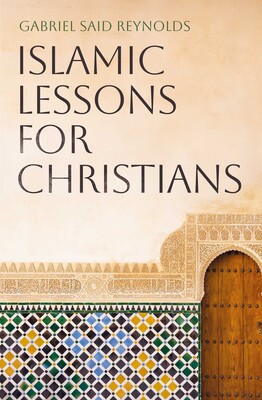
دروس إسلامية للمسيحيين
- غابريل سعيد رينولدز
يقترح كتاب «دروس إسلامية للمسيحيين» للباحث غابرييل سعيد رينولدز، أستاذ الدراسات الإسلامية واللاهوت في جامعة نوتردام، سبيلاً جديداً للحوار الإسلامي-المسيحي. ماذا يمكن أن يتعلّم المسيحيون من الإسلام؟...

article
الرسالة العامة «الإنسانية الرائعة» للبابا ليون الرابع عشر ومجموعة عمل Pluriel حول الحوار بين الأديان بمساعدة الذكاء الاصطناعي
نص بقلم وائل صالح، باحث في جامعة كيبيك في مونتريال (UQAM) وعضو في لجنة تنسيق المنصة الجامعية للدراسات حول الإسلام (Pluriel). إن تزامن صدور الرسالة العامة الإنسانية الرائعة (Magnifica humanitas) ...
publication
اعترافُ طائرٍ طنّان: مقالاتٌ في الحوار بين الأديان والعمل الإرسالي (2007-2025)
- ريمي كوكاناس
صدر هذا الكتاب في أيار/مايو 2026 عن المعهد الحبري للدراسات العربية والإسلامية (PISAI) في روما، ويضمّ مقالات الباحث ريمي كوكاناس حول الحوار بين الأديان والعمل الإرسالي، المكتوبة بين عامَي 2007 و2025...